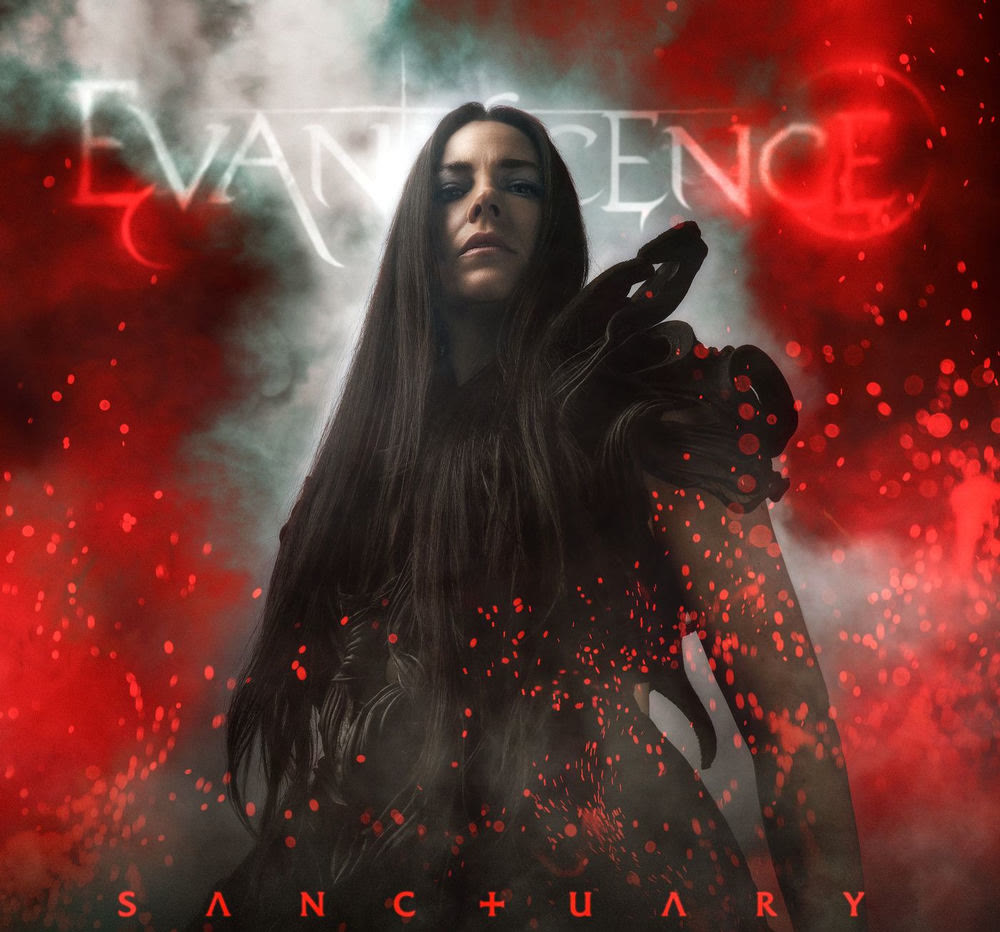
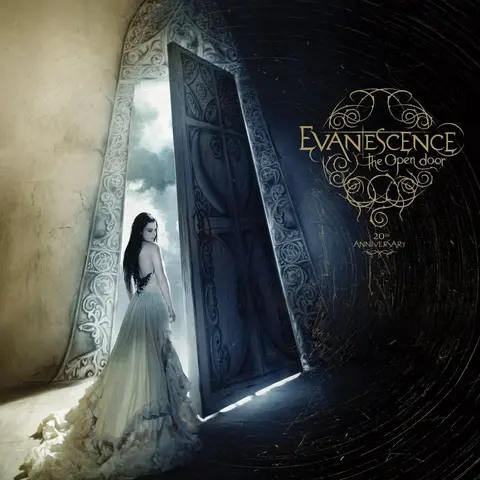
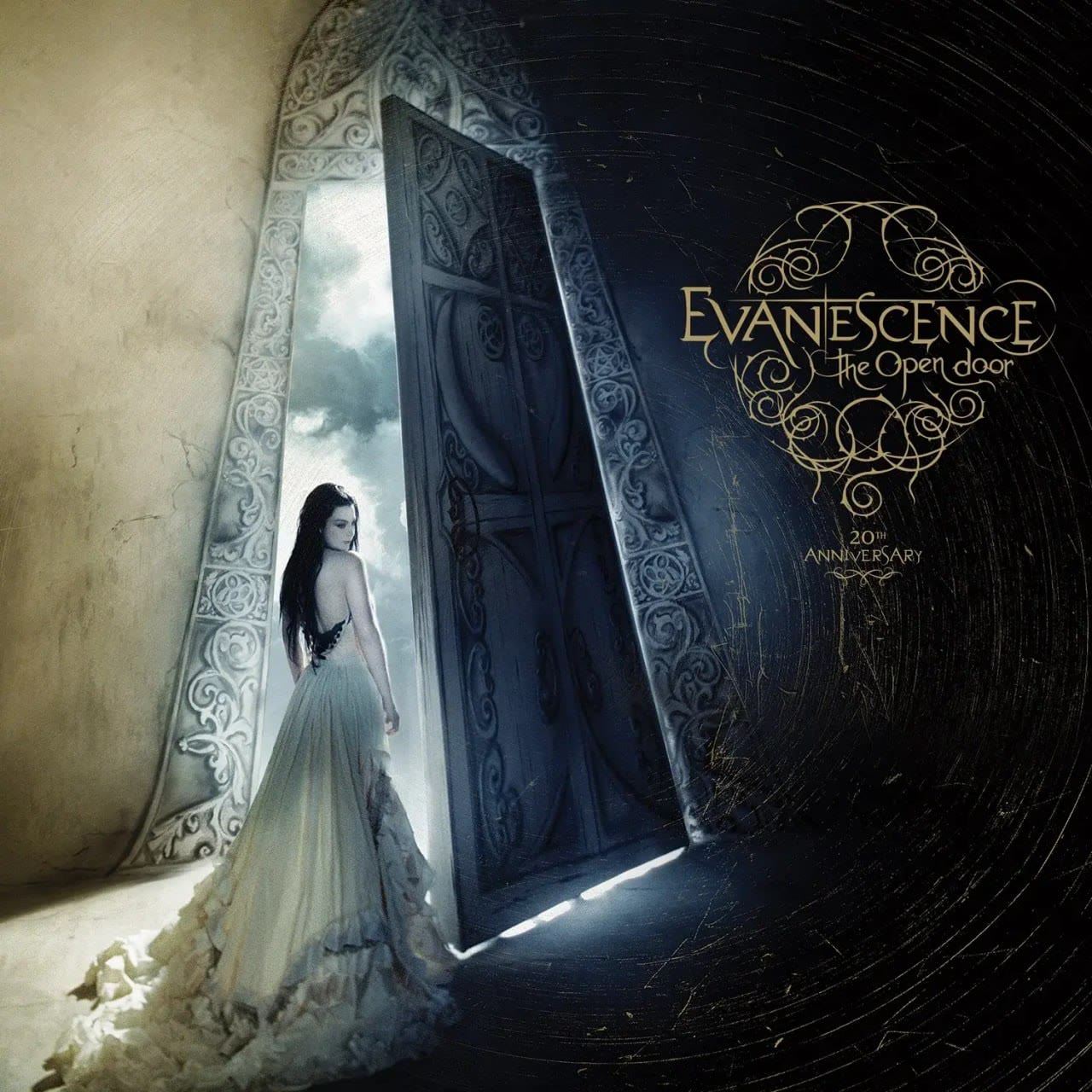
On November 6, 2026, Evanescence’s “The Open Door” returns in a newly remastered and expanded 20th Anniversary Deluxe Edition. The timing is almost theatrically perfect. Twenty years after Amy Lee opened the album with a voice that seemed to be clawing its way out of a burning cathedral, Evanescence are entering a new chapter with “Sanctuary”, their sixth studio album, released in June 2026. One record was about escape, self-possession and the violent relief of finally saying everything out loud. The other is built around music as refuge.
Between those two doors lies the whole emotional history of Evanescence.
The anniversary edition restores the original 13-track album alongside four additions: “If You Don’t Mind ↗,” “Together Again ↗,” “The Last Song I’m Wasting On You ↗,” and a previously unreleased demo of “Good Enough ↗.” It arrives on 2-LP, CD and digital formats, revisiting the album that first appeared internationally on September 25, 2006, before its United States release on October 3.
But “The Open Door” was never simply a successful follow-up to “Fallen”. It was Amy Lee’s declaration that Evanescence would not remain frozen inside the image that had made them famous.
The album after the miracle
When “Fallen” exploded in 2003, Evanescence became one of the defining rock bands of the decade almost overnight. The album’s mixture of metallic guitar, piano, orchestration and Lee’s enormous, sorrowful voice made room for a different kind of woman in mainstream heavy music: not a decorative frontperson, not a singer waiting for the guitars to tell her what to feel, but a writer and musician standing at the center of the storm.
The success brought Grammy Awards, global attention and an impossible burden. It also magnified the internal tensions of the band. Co-founder and guitarist Ben Moody, Lee’s longtime songwriting partner, left during a European tour in 2003. Former Cold guitarist Terry Balsamo became her principal collaborator for the next record. Bassist Will Boyd departed during the album’s development. Lee changed managers and became involved in legal conflict with her former representative. Her relationship with Seether frontman Shaun Morgan ended. During the recording process, Balsamo suffered a stroke after a torn neck artery.
By the time “The Open Door” was made, almost every structure around Lee had shifted.
A contemporary Washington Post profile described the record as the first Evanescence album on which Lee had taken control of her life and art. Lee herself spoke about having to move through “so many things” before reaching what she called a better place.
The point was not that Lee had suddenly become invulnerable. The point was that she no longer wanted to disguise vulnerability as compliance.
“I really did everything that I couldn’t do before, or was afraid to do before.”
That sentence explains the album better than any marketing language ever could.
Amy Lee takes the wheel
The Open Door’s creative freedom was audible in its construction. Lee and Balsamo spent approximately 18 months developing the material, and the pair shared writing credits on nine of the album’s 13 songs. Producer Dave Fortman returned from “Fallen”, but the musical center had changed. This was no longer a record shaped by the tension between Lee and Moody. It was a record shaped by Lee’s expanding imagination.
The album pushed Evanescence further into orchestration, electronic texture, choral arrangement and unconventional song structure. Piano and guitar were not treated as separate identities; they were woven together, sometimes fighting for space, sometimes moving as one instrument. Lee’s classical background became more than an atmospheric accent. It became part of the album’s architecture.
She described the writing process as unusually liberating: a place where the studio became a space to experiment, trust the musicians around her and see what emerged. The Los Angeles Times characterized “The Open Door” as Lee’s debut as Evanescence’s undisputed leader, a record positioned between pop accessibility and heavy-rock force.
That position was uncomfortable for some listeners. Contemporary critical reaction was divided. Billboard and Entertainment Weekly recognized the album’s scale and emotional depth, while other reviewers accused it of overstatement, sameness or excessive melodrama. Metacritic’s contemporary roundup reflected that split, with praise for Lee’s confidence and control alongside complaints that the songs sometimes blurred together.
For a band with a woman at its center, the criticism often carried an additional implication: that emotional excess was somehow evidence of artistic weakness. Male metal musicians could be theatrical, grandiose and wounded. Lee was frequently expected to justify every dramatic gesture.
She never really did.
“Call Me When You’re Sober”: the public boundary
The album’s first single turned private pain into public spectacle. “Call Me When You’re Sober ↗” was direct enough that listeners quickly connected it to Morgan and the addiction issues surrounding their relationship. Lee initially resisted explaining the song in detail, but she later acknowledged its subject while emphasizing the larger experience of loving someone whose behavior keeps causing harm.
Musically, the song was a brilliant introduction to Evanescence 2.0. Lee and Balsamo transformed a melody she had initially questioned into a sharply structured rock song built on tension, release and a guitar riff that gave the chorus physical weight. Its sound was heavier than a conventional power ballad but more theatrical than standard alternative metal.
The video heightened the drama. Directed by Marc Webb, it recast Lee as a defiant Little Red Riding Hood opposite a seductive Big Bad Wolf. The fairy tale was not subtle, but that was precisely the point: Lee was taking a story about female vulnerability and rewriting its ending in front of millions of viewers.
“I had to be true to the music.”
That was the risk. Lee knew the song would generate gossip. She also knew that softening it would make the record less honest. For fans who had spent years using Evanescence’s music to survive emotional confusion, the song offered something different from consolation. It offered a boundary.
“Lithium”: choosing feeling over numbness
If “Call Me When You’re Sober” was confrontational, “Lithium ↗” was conflicted. Built around a piano melody Lee had written as a teenager, the song explored the attraction of emotional numbness and the fear of giving up sorrow, even when sorrow has become familiar.
The title invited obvious comparisons with Nirvana, but Lee’s song was not a cover or response. She described lithium as a metaphor for happiness viewed from a negative angle, a state that can flatten pain but also flatten the self.
That tension is what makes the song so enduring. Lee does not present healing as a clean break. She presents it as an argument with the self. One part wants to remain inside the sadness because sadness is known territory. Another part wants to risk feeling something else.
The arrangement mirrors that uncertainty. The piano remains exposed, almost fragile, while the band enters in waves rather than simply detonating behind her. Lee’s performance moves from restraint to full-throated release, but the emotional climax never feels like a victory lap. It feels like someone standing at the edge of change, terrified of what freedom might require.
Kerrang! later recognized “Lithium” as one of the band’s essential songs, emphasizing its combination of classical piano, metallic force and Lee’s unusually wide vocal range.
“Sweet Sacrifice”: survival with teeth
“Sweet Sacrifice ↗” is the album’s physical blow. It arrives with a hard riff, tense strings and an almost aggressive vocal performance from Lee. Where “Lithium” questions whether pain can be released, “Sweet Sacrifice” sounds like the moment the body finally understands that it has been used.
The song reached back toward the abusive relationship that had informed parts of “Fallen”, but it did not sound trapped in the past. Its defining emotion is not despair. It is refusal.
The chorus turns the language of victimhood inside out. Lee sings from the position of someone who has recognized the pattern and is no longer willing to romanticize endurance. The title itself is bitterly ironic: the sacrifice may once have been called love, loyalty or devotion, but the song exposes what that role costs.
Kerrang! later described the track as a potent statement of where Evanescence stood in 2006, with Lee sounding “unchained” rather than defeated. The song’s impact was strong enough that fan and band pressure helped elevate it to the album’s third single.
It also remains one of Lee’s most demanding songs to perform. In a later fan Q&A, she identified “Sweet Sacrifice” as one of the hardest Evanescence songs to sing live with consistency. That difficulty matters. The song’s apparent control is built on physical exertion. It is not merely an anthem about escape; it sounds like escape taking place in real time.
“Lacrymosa”: Mozart enters the arena
“Lacrymosa ↗” is where “The Open Door” becomes something more ambitious than a gothic-rock blockbuster. Lee took the “Lacrimosa” movement from Mozart’s “Requiem”, her favorite piece of music, and reimagined it as a dark, symphonic metal composition.
The recording included a 22-piece orchestra and the Millennium Choir, captured in a chapel. The result is not a polite classical quotation placed over rock instrumentation. It is a collision: Mozart’s mourning pushed through distorted guitars, electronic atmosphere and Lee’s modern, wounded voice.
This was the kind of gesture that could easily have collapsed under its own grandiosity. Instead, “Lacrymosa” understands that melodrama can be serious when it is earned. The song does not apologize for grief or reduce it to tasteful sadness. It makes grief architectural.
That was one of Evanescence’s great gifts to mainstream rock. The band made the emotional scale of symphonic music feel compatible with radio, MTV-era spectacle and metal festival stages. “Lacrymosa” did not turn classical music into decoration. It turned it into a weapon.
A scene divided by the spectacle
The metal community’s relationship with Evanescence was complicated from the beginning. The band were too melodic for some traditional metal listeners, too theatrical for certain hard-rock purists and too heavy for sections of the pop audience. “The Open Door” intensified that contradiction.
Some critics heard repetition and overproduction. Others heard a band refining its identity after the departure of Moody. AllMusic noted that the second album captured the Evanescence aesthetic more consistently than “Fallen”, even while arguing that not every song landed with equal force.
The very qualities that made Evanescence meaningful to young women and outsiders, ornament, emotional directness, piano, orchestration, visible vulnerability, were often treated as evidence that the band was somehow less legitimate than male-fronted heavy acts.
Yet the album’s chart performance and longevity tell another story. “The Open Door” debuted at number one on the Billboard 200, selling more than 447,000 copies in its first week, and reached number one in several international markets.
Its influence is not measured only in sales. It can be heard in the growing number of women who entered heavy music without feeling obliged to choose between beauty and aggression, technical control and emotional openness, theatricality and seriousness. Evanescence helped prove that a song could be both a metal performance and a private confession.
Does “The Open Door” remain the most uncompromising Evanescence album?
The answer depends on what kind of uncompromising we mean.
“The Bitter Truth” carried the anger of a later era. “Synthesis” revisited the band’s catalog through orchestral transformation. “Sanctuary”, released on June 5, 2026, arrives from a different emotional position: music as a place of connection and safety in a frightening world. The band’s current era is not a retreat from heaviness, but it is more openly communal.
Amy Lee has described music as a spiritual process and explained that she now allows years between albums so ideas can develop without being forced by commercial schedules. That patience is part of the Sanctuary era’s meaning. The music is no longer only about surviving the room. It is about building a room where other people can survive too.
But “The Open Door” remains uniquely exposed.
It was made when Lee was still close enough to the chaos to bleed from it, yet strong enough to shape that chaos into something deliberate. It contains anger, grief, fear, desire, guilt, theatricality and relief without trying to make them polite. “Call Me When You’re Sober” drew a line. “Lithium” questioned numbness. “Sweet Sacrifice” turned endurance into defiance. “Lacrymosa” made mourning vast enough to fill a cathedral and loud enough to shake a festival field.
The new anniversary edition does not need to prove that the album was perfect. It only needs to remind us that perfection was never its purpose.
“The Open Door” was about the dangerous moment after a person stops asking permission to feel. Twenty years later, it still sounds like Amy Lee walking through that opening, and daring the rest of us to follow.