
The admission arrives twenty-one years late
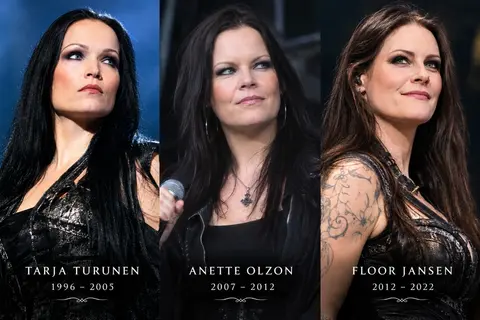
On October 21, 2005, after Nightwish’s final concert with Tarja Turunen at Helsinki’s Hartwall Arena, Tuomas Holopainen handed the singer an open letter signed by the other musicians. The band had just completed the tour that followed “Once ↗”, the album that transformed Nightwish from a Finnish phenomenon into an international symphonic-metal force. Then, almost immediately, the story changed from triumph to expulsion.
The letter was published publicly. It accused Turunen of placing money, business interests and her solo career above the band, while also directing anger toward her husband and manager, Marcelo Cabuli. Holopainen, Emppu Vuorinen, Jukka Nevalainen and Marco Hietala announced that Nightwish would continue without its original singer. The wording was emotional, prosecutorial and impossible to contain once it entered the world.
In September 2026, Holopainen finally conceded what many fans had believed for two decades: Nightwish deserved the backlash.
We got blamed for what happened, and for good reason.
- Tuomas Holopainen, Nightwish keyboardist
That admission is significant, even though it is not a complete reversal. Holopainen has continued to argue that there was no future for Nightwish in its existing form and that the internal situation had become unbearable. He is not saying that ending the relationship was necessarily wrong; he is acknowledging that delivering it as a public letter directly after the band’s biggest concert to date inflicted a wound far deeper than a private professional separation would have done.
Four musicians had built a remarkable artistic world with Tarja Turunen, yet they chose to turn a private rupture into a permanent piece of public theatre.
Before the letter, there was a band
Nightwish began in Finland in 1996, when Holopainen, Vuorinen and Turunen developed the idea that would become one of the defining bands of symphonic metal. Turunen was nineteen when she joined. Her classical training, operatic technique and commanding stage presence gave shape to the band’s early musical identity, while Holopainen supplied the orchestral imagination and songwriting.
The mythology of Nightwish has always depended on the meeting of those two forces: the songwriter’s private fantasy and the singer’s extraordinary physical voice. Holopainen wrote songs filled with oceans, childhood, longing, death and impossible worlds. Turunen gave them a human body. Her voice could sound remote and celestial, but it could also cut through the grand arrangements with unmistakable vulnerability.
By the time “Once” arrived in 2004, that chemistry had become commercially powerful. The album included “Nemo ↗” and “Wish I Had an Angel ↗,” both officially released as singles from the record. “Nemo” carried the atmosphere of someone searching for a name, a place or a self that had been lost. “Wish I Had an Angel” was more muscular and immediate, driven by the friction between Turunen’s operatic voice and Hietala’s rougher vocals.
Neither song is a direct document of the 2005 split. That is precisely why they are so revealing. They belong to the period before the public rupture, when Nightwish still sounded like a collective creation rather than a contested inheritance. Yet both songs are haunted by emotional distance. Their speakers reach for something that cannot be held securely. They desire intimacy and distrust it at the same time.
Fans later returned to those songs with knowledge of what came next. The music did not change, but its emotional geography did. “Nemo” became more than a grand single about alienation. It became part of the soundtrack to a band whose own internal bonds were about to be broken in front of the world.
The open letter as a public verdict
The central problem with the 2005 letter was the imbalance of power created by presenting one side’s account as the definitive explanation before Turunen had a meaningful opportunity to respond.
The band described itself as having reached a point where business and outside interests had overtaken the emotional foundation of Nightwish. The letter’s language suggested incompatibility and betrayal, implying Turunen had failed the band’s original ideal. The personal and professional were fused together, leaving little room for ambiguity or mutual responsibility.
Turunen’s response was equally public, yet emotionally different. In later interviews, she described the dismissal as shocking and said she had not expected it. In 2026, she recalled the aftermath as a period in which her family, friends and sense of trust were deeply affected. She said she left Finland for Buenos Aires as the story dominated the country’s tabloids.
There is a human detail here that often disappears beneath the mythology: Nightwish dismissed a person who had been present from its beginning, whose voice was inseparable from its formative recordings, and whose identity had become publicly tied to the group’s success. Turunen had every right to be held accountable for professional disagreements, yet accountability differs sharply from humiliation, and a band’s grievance gains no legitimacy from being published immediately after a sold-out farewell performance.
Holopainen’s 2026 admission recognizes that. The backlash came because the letter made the audience witness a private conflict without giving the dismissed singer equal control over the narrative.
The songs that turned pain into Nightwish mythology
The split reshaped Nightwish’s music almost immediately. On “Dark Passion Play”, released in 2007, Holopainen transformed the crisis into an album-length emotional landscape. Anette Olzon had joined the band after an extensive search, and her voice offered a different kind of presence: lighter, more pop-oriented, warmer and less classically imposing than Turunen’s.
The album’s opening song, “The Poet and the Pendulum ↗,” is one of the clearest examples of Nightwish turning personal anguish into grand theatrical narrative. It is almost fourteen minutes long, and its lyrics present the songwriter as a wounded figure trapped inside his own creation. Holopainen has described the song as an act of figuratively killing himself in the lyrics, a way of processing the emotional collapse surrounding the band.
But the song’s power also exposes the limits of the band’s self-mythologising. “The Poet and the Pendulum” is moving because it sounds genuinely distressed. It is also troubling because the central emotional drama is still largely told from Holopainen’s point of view. Turunen becomes part of the catastrophe, but not its narrator. The songwriter is the wounded poet; the band is the endangered home; the dismissed singer is part of the force that made survival necessary.
That pattern continued in “Bye Bye Beautiful ↗” and “Master Passion Greed ↗,” songs widely understood as addressing the breakup and Holopainen’s hostility toward Cabuli. “Bye Bye Beautiful” was eventually withdrawn from the band’s live repertoire, an acknowledgment that the song’s bitterness had not aged comfortably.
This is where the distinction between confession and absolution becomes important. The songs reveal pain, but pain does not automatically establish moral innocence. A person can be genuinely hurt and still hurt someone else. Nightwish’s post-Turunen catalogue became an archive of Holopainen’s grief, anger and guilt, but it was not a court transcript. It preserved one emotional truth rather than the whole truth.
Anette Olzon and the burden of replacement
Olzon entered Nightwish at the worst possible moment for any singer: when the audience was still grieving, arguing and comparing. Her first album with the band, “Dark Passion Play”, sold the promise of continuation. Her presence also made clear that Nightwish could survive without reproducing Turunen’s exact sound.
That distinction is important. Olzon was not a failed Tarja. She was asked to inhabit a role that had already become mythological, while being judged against a voice that had shaped the band’s entire first decade. Her interpretation of Nightwish was more conversational and melodic, and it gave songs such as “Amaranth ↗” a different kind of accessibility. The band’s ability to continue did not erase what had been lost. It demonstrated that Nightwish was both a collective and a project driven heavily by Holopainen’s compositions.
The second rupture arrived in 2012, when Nightwish and Olzon separated during the “Imaginaerum” touring cycle. The band announced that the decision had been mutual and that they would continue the tour with Floor Jansen, who had joined them onstage in Seattle on October 1, 2012. Olzon later disputed aspects of the band’s account, particularly the circumstances around her departure, while Nightwish issued its own rebuttal.
The contrast with 2005 is revealing. Nightwish had learned that a singer’s exit could become a public crisis, but it had not entirely learned how to keep the crisis from becoming a public battle. The language was less openly theatrical, yet the underlying pattern remained: the band’s official version appeared first, and the woman leaving had to fight for space inside the story.
Floor Jansen changed the question
Floor Jansen’s arrival was initially an emergency measure. It became something much larger. A veteran vocalist with a broad range, commanding technique and experience in both metal and theatrical performance, Jansen could move between Turunen-era material, Olzon-era songs and newer compositions without sounding like an impersonator of either predecessor.
She joined Nightwish as a touring singer in 2012 and became an official member in 2013. She recorded three studio albums with the band: “Endless Forms Most Beautiful ↗” in 2015, “Human. :II: Nature.” in 2020 and “Yesterwynde” in 2024.
Jansen’s importance was not simply vocal. She helped break the idea that Nightwish’s identity depended on one irreplaceable female archetype. Turunen represented the band’s operatic origin; Olzon represented its attempt to survive a devastating split; Jansen represented a mature synthesis of power, flexibility and emotional authority.
Her relationship with the audience was also shaped by the history she inherited. She had to perform songs connected to former singers while avoiding the appearance of erasing them. In doing so, she became a bridge between different versions of Nightwish’s past.
That bridge ended on October 15, 2026, when Nightwish and Jansen announced that they had mutually agreed to part ways. The band said it would continue and enter the studio in 2027. Jansen said her solo career and forthcoming album “Hytress” would now receive her full attention.
In a subsequent interview, Jansen compared the split to the end of a relationship: if people can no longer get through the difficult periods together, she said, then it is over. She did not describe the separation as a public war. Her language was gentler, more contained and notably less interested in assigning blame.
What remains after the mythology
Nightwish now stands at an unsettling threshold. The band has no announced replacement for Jansen, no current live dates and a future studio album planned for 2027. Holopainen has indicated that a live return may not come until 2028. The group’s present uncertainty is not only logistical. It is existential.
For three decades, Nightwish’s history has been narrated through the arrival and departure of women whose voices became central to the band’s emotional identity. Each transition produced new music, new fans and new arguments about authenticity. But the repeated pattern has also forced the metal community to ask difficult questions about power: Who gets to define what happened? Who speaks first? Who is treated as the author of the band’s future, and who is treated as replaceable?
Holopainen’s 2026 admission does not undo the letter of 2005. It cannot return Turunen to the years she lost with the band, and it cannot erase the public shame of being dismissed before a global audience. Nor should it reduce her career to the story of what Nightwish did to her. Turunen built a substantial solo life, continued working across metal and classical music, and eventually shared the stage again with former Nightwish bassist Hietala. Her voice outlasted the institution that once claimed it.
The enduring lesson is clear: bands sometimes reach endings that are necessary, yet necessity never justifies cruelty, and artistic survival requires no public execution.
The music remains immense. “Nemo” still carries the ache of searching. “Wish I Had an Angel” still crackles with desire and mistrust. “The Poet and the Pendulum” still sounds like a composer trying to survive his own emotional wreckage. But now those songs can be heard as more than chapters in Tuomas Holopainen’s mythology. They are also reminders of the women who gave Nightwish its voice, the audiences who were asked to take sides, and the human cost of turning private pain into permanent legend.
Nightwish has always made music about longing for another world. The difficult truth is that no fantasy world can protect real people from the consequences of how they treat one another.