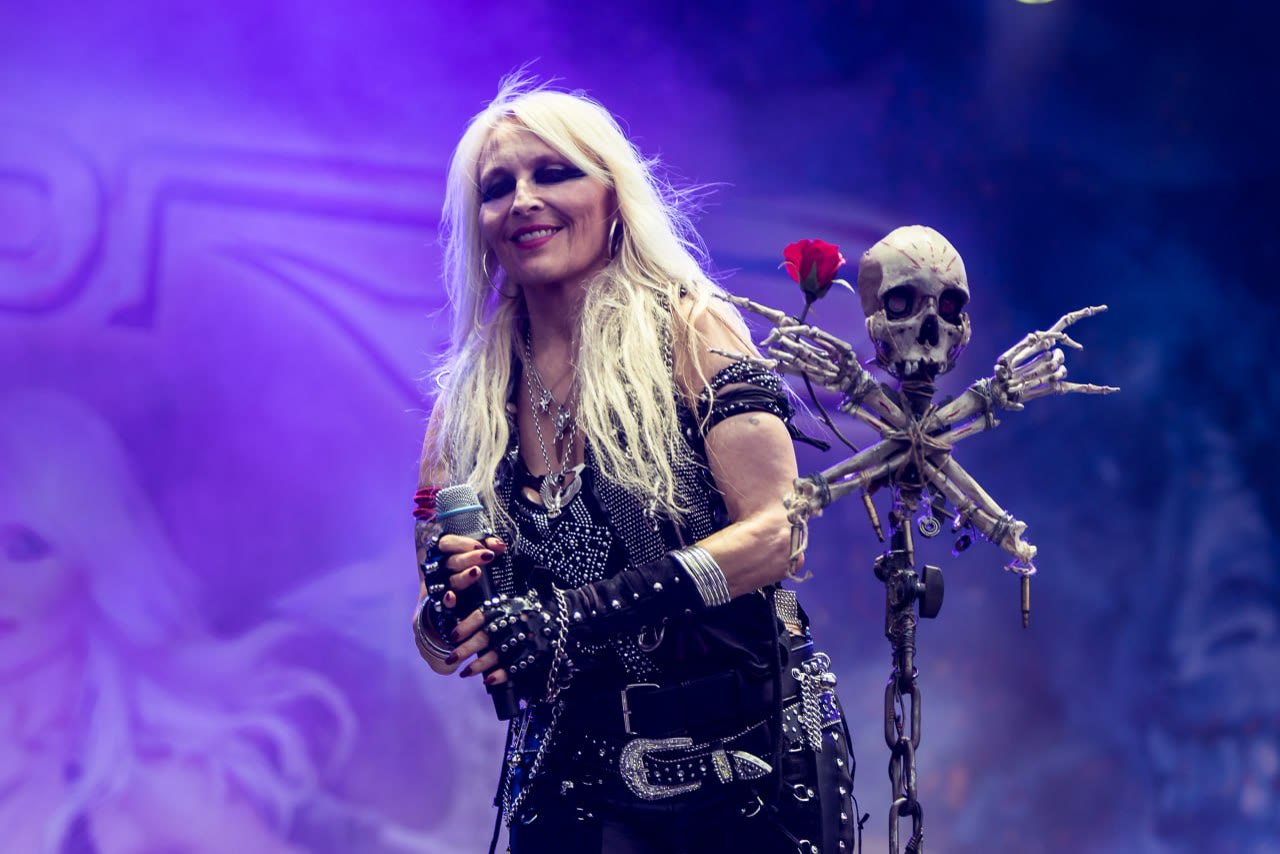
The voice that never left the stage
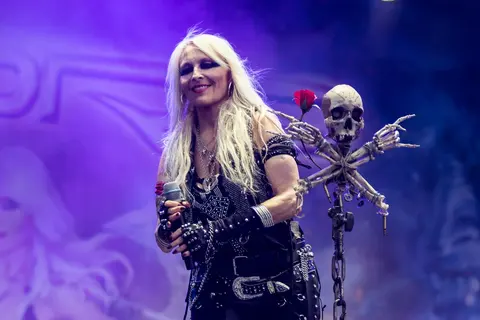
Doro Pesch has spent more than four decades proving that a metal career does not have to be a museum piece. She carries the memory of the 1980s without being trapped inside it, sings old songs without treating them as relics, and continues to approach every concert as though it might be the one that changes everything.
In 2026, Doro remains what generations of fans have called her: the Metal Queen. The title means more than longevity; it speaks to a particular kind of emotional authority. Doro gives heavy metal a human face. Her voice can be hard-edged, soaring, wounded or joyful, sometimes within the same song, and her stage presence is built on connection. She wants the audience to feel stronger when they leave than when they arrived.
Every time, I feel like I want to do my best concert.
- Doro Pesch, vocalist
That instinct began long before Warlock, international tours or the word “icon” was attached to her name. Doro has recalled hearing Little Richard’s “Lucille ↗” when she was three years old and immediately knowing that she wanted to become a singer. At fifteen, she joined her first band, Snakebite, before moving through Beast and Attack and eventually helping form Warlock in Düsseldorf.
The story is almost deceptively simple: a child hears a record, a teenager finds a band, and a singer discovers a life. But Doro’s career has always been defined by what happened after the dream became difficult. She made her own path by continuing.
Before the crown, there was a young singer from Düsseldorf
The early Doro story has a roughness that suits the music. Her first performances were confrontational, chaotic and alive. In one account of Snakebite’s first gig, the band played a Düsseldorf punk club where metalheads and punks occupied the same room uneasily. The performance ended with punks storming the stage and destroying equipment. It was hardly a conventional beginning, yet it placed Doro in the middle of the energy that would shape her: loud music, strong personalities and an audience that demanded authenticity.
She was also a graphic artist before music became her full-time profession. When Warlock secured a major tour with Judas Priest in 1986, Doro quit her job and chose the uncertain road. She has said that, before then, the band had not imagined the music would become a lifelong occupation. They thought perhaps they might have three, four or five years. Instead, the commitment became more than four decades of recording and touring.
That leap matters when considering Doro’s voice. It is the sound of someone who repeatedly chose the harder option: the road over security, the stage over predictability, the band and the fans over outside expectations.
Warlock’s first album, “Burning the Witches”, arrived in 1984, followed by “Hellbound”, “True as Steel” and “Triumph and Agony”. The band’s sound combined traditional heavy metal force with melody, drama and a frontwoman who could command a song without disguising her femininity or softening her intensity. Doro stood in the same storm as the men around her and made it hers.
The night Lemmy steadied her
One of the defining images of Doro’s early career comes from the 1986 Monsters of Rock festival at Castle Donington. Warlock played a bill that included Scorpions, Motörhead, Def Leppard and Ozzy Osbourne. Doro has remembered approaching the stage and discovering that the crowd was vastly larger than she had imagined, around 80,000 people, rather than a few thousand. She was shaking with nerves when she encountered Lemmy Kilmister. He told her to have a great show, noticed how frightened she was, hugged her and kissed her forehead.
The photograph of that moment has become more than a piece of rock history. It captures the relationship that would grow between two musicians who understood the emotional cost of living publicly and honestly.
Lemmy was definitely my best friend.
- Doro Pesch, vocalist
Doro met Lemmy in the early 1980s, at a time when she could barely speak English. Their friendship developed through tours, festivals, studio sessions and long stretches of simply being together. After the death of Doro’s father, Lemmy called her and helped pull her out of grief. In 2000, she travelled to Los Angeles to work on “Calling the Wild”. What was supposed to be a short visit expanded into weeks of driving, talking, laughing and listening to music.
The details are intimate because they are ordinary. In Doro’s recollections, Lemmy was the friend saying keep moving, drive somewhere, do not stop living.
I was a little lost. Lemmy breathed new life into me.
- Doro Pesch, vocalist
Their musical connection produced “Love Me Forever,” Doro’s first duet, recorded for “Calling the Wild”. Years later, they worked together again on “It Still Hurts ↗,” a song whose emotional weight comes from the contrast between Doro’s open-hearted delivery and Lemmy’s weathered, unmistakable voice. Doro’s official discography lists both collaborations as part of their shared musical history.
After Lemmy’s death in 2015, Doro continued to speak of him as a person she missed every day. In 2026, she told Rock Overdose that he was honest, intelligent, free-spirited and possessed of a “heart of gold.” She also described receiving a cartridge containing some of his ashes, a private remembrance she keeps in a secret place.
That tenderness sits at the center of Doro’s public strength. She can sing like a warrior while carrying enormous capacity for affection.
“All We Are” and the sound of belonging
If “Love Me Forever” is part of Doro’s private mythology, “All We Are ↗” is her communal one.
Written and recorded during the Warlock era, the song became an anthem because its hook was direct enough for an entire room to claim. Doro has explained that she wanted a gang vocal rather than a polished professional choir. Friends, metal fans and people gathered from the street were brought into the studio at Power Station in Manhattan. They sang the chorus repeatedly because the experience made them happy.
It also has a great message. It’s about being united, being friends.
- Doro Pesch, vocalist
That is why the song has outgrown its original recording. “All We Are” asks the audience to participate, turning a concert into a temporary family and a roomful of strangers into one breathing voice.
Doro says she has played the song at virtually every concert since 1987. She still hears the same emotional response that greeted it during Warlock’s tour with Ronnie James Dio, when crowds demanded it again after the encore. Almost 40 years later, she continues to identify “All We Are” as the Warlock song she would save if everything else disappeared.
Beside it stands “Für Immer ↗,” the aching ballad from “Triumph and Agony”. Its German lyrics have never prevented the song from reaching listeners beyond Germany. Doro has said that it touches people even when they do not understand every word. That is one of the clearest descriptions of her artistry: she trusts the emotional truth of a performance to cross borders that language cannot.
“All We Are” is Doro in collective mode. “Für Immer” is Doro alone with the wound. Together, they explain why Warlock remains central to her identity.
Losing Warlock, becoming Doro
The transition from Warlock to Doro was forced by a legal dispute over the band’s name. Doro has repeatedly said that she never intended to become a solo artist; after the rights to Warlock were lost, she continued under her own name because she wanted to keep making music. It took years before she regained control of the Warlock name.
That history gives the name “Doro” a complicated meaning. It represents independence, and it also carries the memory of something taken away. Her solo career had to grow out of an imposed rupture, so she made the new name strong enough to hold the old one.
The 1990s tested that strength. Doro worked with Gene Simmons on her first major solo album, moved through records such as “True at Heart”, “Angels Never Die” and the industrial-tinged “Love Me in Black”, and endured a period when record companies were increasingly focused on grunge and less interested in traditional metal. She has remembered that era with frustration, and with the resilience that has become one of her defining traits.
When heavy metal regained cultural momentum, Doro was already waiting. Albums including “Calling the Wild”, “Fight”, “Fear No Evil”, “Raise Your Fist” and “Forever Warriors, Forever United” reaffirmed her commitment to anthems, melodic heaviness and direct emotional communication. Her collaborations expanded across generations, while keeping her own identity intact.
A bridge to the next generation
Doro’s importance to women in heavy music goes deeper than surviving in an era when female metal singers were rare. She proved a woman could remain the center of a heavy band without making her gender the entire story.
She could be glamorous without being ornamental, emotional without being fragile, and commanding without needing to imitate masculine aggression. Her influence can be felt in the women who followed her into metal’s most demanding spaces, as artists who inherited the possibility she helped make visible.
That bridge becomes especially vivid on “Wild At Heart”, her forthcoming album, scheduled for release on 11 December 2026. Doro has described it as a roughly nine-song collection combining anthems, heavy tracks and ballads. It will include a collaboration with Alissa White-Gluz, one of the defining modern voices in extreme metal. The pair recorded a live version of Warlock’s “Touch of Evil ↗,” following White-Gluz’s appearance at one of Doro’s anniversary shows.
The collaboration is meaningful because it bridges two eras. Doro’s metal is rooted in the melodic and traditional canon; White-Gluz’s artistic language has been shaped by the modern extreme-metal era. Their meeting suggests continuity across difference: one voice carries the memory of the road that came before, while the other brings the force of a scene that has expanded, diversified and grown more technically ferocious.
Doro has also singled out “You Are Not Alone,” an emotional power ballad, and “Fight Like a Lion,” a heavier track with what she described as a Metallica-like character. The album’s title captures her refusal to surrender the emotional instinct that made her choose music in the first place.
The wild heart still beats
Doro’s collector-minded approach to the album, shaped vinyl, picture discs, a box set and even a liquid-filled red-glitter edition, also reveals something essential about her relationship with metal. She keeps the physical, theatrical and communal dimensions of the culture alive: she still loves records as objects, shows as rituals and fans as collaborators in the music’s meaning.
Her plans after “Wild At Heart” are characteristically practical and expansive: touring, festivals and anniversary celebrations around “Triumph and Agony”, originally released in 1987. The future, for Doro, means another setlist, another stage, another night in which the audience may sing louder than the band.
She has said she wants to keep performing as long as she is healthy, following the example of Lemmy by living fully and making people happy. She treats legacy as something you keep feeding.
Doro Pesch remains a bridge between eras because she never stopped walking. Behind her are Warlock, “All We Are,” “Für Immer,” Monsters of Rock, Ronnie James Dio, Lemmy and the difficult birth of her solo career. Ahead is “Wild At Heart”, with Alissa White-Gluz beside her and another generation listening.
The Metal Queen is still singing because she continues to choose the stage.
I want to give it my all every day.
- Doro Pesch, vocalist