The mountain beneath the music
Lzzy Hale has spent most of her life learning how to turn pressure into sound.
Long before the arenas, the Grammy, the signature guitars and the impossible vocal peaks, there was a Pennsylvania teenager with a piano, a guitar and a younger brother who wanted to play drums. Lzzy and Arejay Hale began writing and performing together in 1997, raised on Black Sabbath, Pat Benatar and Alice Cooper. Halestorm did not arrive fully formed. They worked their way through bars, restaurants, clubs and whatever strange assignments would pay for the next step, including, memorably, a funeral gig where the young band played cover songs for mourners who did not applaud.
That history matters because “Everest”, Halestorm’s sixth album, does not sound like a band trying to manufacture a breakthrough. It sounds like a band confronting the accumulated weight of its own survival.
For Hale, the climb had become personal. The vocalist and guitarist entered the making of “Everest” after a period of sobriety, depression, anxiety, professional exhaustion and painful self-examination. She was not simply looking for a new sound. She was trying to understand what remained when the old escapes stopped working, when the machinery of touring no longer concealed the fear underneath it, and when the person everyone expected her to be became impossible to maintain.
The result is not a clean recovery narrative. “Everest” does not pretend that struggle ends with a single revelation or that darkness can be defeated by a triumphant chorus. Hale has described the album as reality rather than despair or hope, a record willing to leave its questions unresolved.
That honesty is what gives the album its force.
The life she built, and the life she had to reassess
By the time Halestorm began recording “Everest”, Hale had been in the same band for nearly three decades. The group’s story is unusually bound together: her brother Arejay remains behind the drum kit, Joe Hottinger has been her longtime musical partner and Josh Smith completes the core lineup. Their career grew steadily rather than overnight, from years of touring to a major-label debut, a Grammy-winning performance for “Love Bites (So Do I) ↗” and a reputation for relentless live work.
The public image of that life is familiar: leather, sweat, jet engines, backstage celebrations and the romantic mythology of the road. But Hale eventually found herself questioning the mythology she had once inhabited.
In interviews surrounding “Everest”, she spoke openly about quitting alcohol in December 2023, after drinking had shifted from something social into something she used to shut down her thoughts and freeze time. She also described reaching a point where she no longer recognized the person she was becoming.
“It stopped being fun.”
That small sentence carries more weight than a theatrical confession. Hale was not presenting sobriety as a glamorous reinvention. She was describing the quiet, frightening moment when a familiar habit reveals itself as a threat.
The emotional cost was compounded by guilt. How could someone living the dream feel depressed, angry or frustrated? How could a singer blessed with a huge audience admit that she was not well? Hale has discussed the pressure to treat gratitude as a substitute for mental health, as though success should cancel out pain. But the mind does not negotiate that way. A full calendar cannot cure depression. A packed arena cannot disprove loneliness.
Hale had advocated for mental-health openness for years, including through the #raiseyourhorns conversation she launched after the death of Huntress vocalist Jill Janus. Yet she found it harder to apply the same compassion to herself. She has spoken about seeking professional help and the fear that asking for it meant she had failed at self-control.
The turning point was not a solitary act of heroic will. It was connection.
During a European tour, a group of young fans who had watched Halestorm repeatedly told Hale that they could see something missing behind her eyes. They offered her permission to stop, rest or step away if she needed to. Later, when she finally acknowledged the seriousness of what she was facing, her bandmates stood beside her. Their response was not judgment but recognition: they had known her for decades, and they were still there.
That support became part of the emotional architecture of “Everest”. The album is about Hale, but it is also about the people who refused to let her carry everything alone.
A creative reset in Savannah
Hale arrived at producer Dave Cobb’s Savannah, Georgia, recording house with a substantial pile of lyrics and song ideas. She had been writing intensely, using poetry as a way to process the emotions she could not always articulate in conversation.
Then Cobb discarded the plan.
Instead of polishing the prepared material, he asked Halestorm to start fresh each day, write in real time and record before the songs had the chance to become overworked. For a band with decades of experience, it was an unsettling demand. Halestorm had to abandon the security of preparation and trust instinct again.
The setting helped. Away from Nashville, families and the daily routines of their established lives, the four musicians found themselves together in a house, effectively recreating the freedom, and irresponsibility, of their teenage years. Hale has described the experience as returning to the beginning, rediscovering why they still wanted to be a band and whether their bond could withstand everything the years had placed upon it.
They discovered that it could.
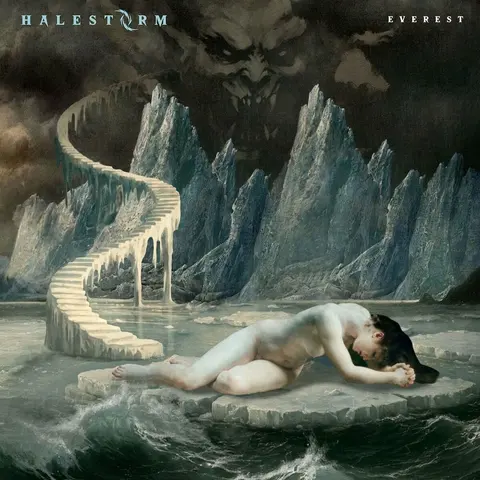
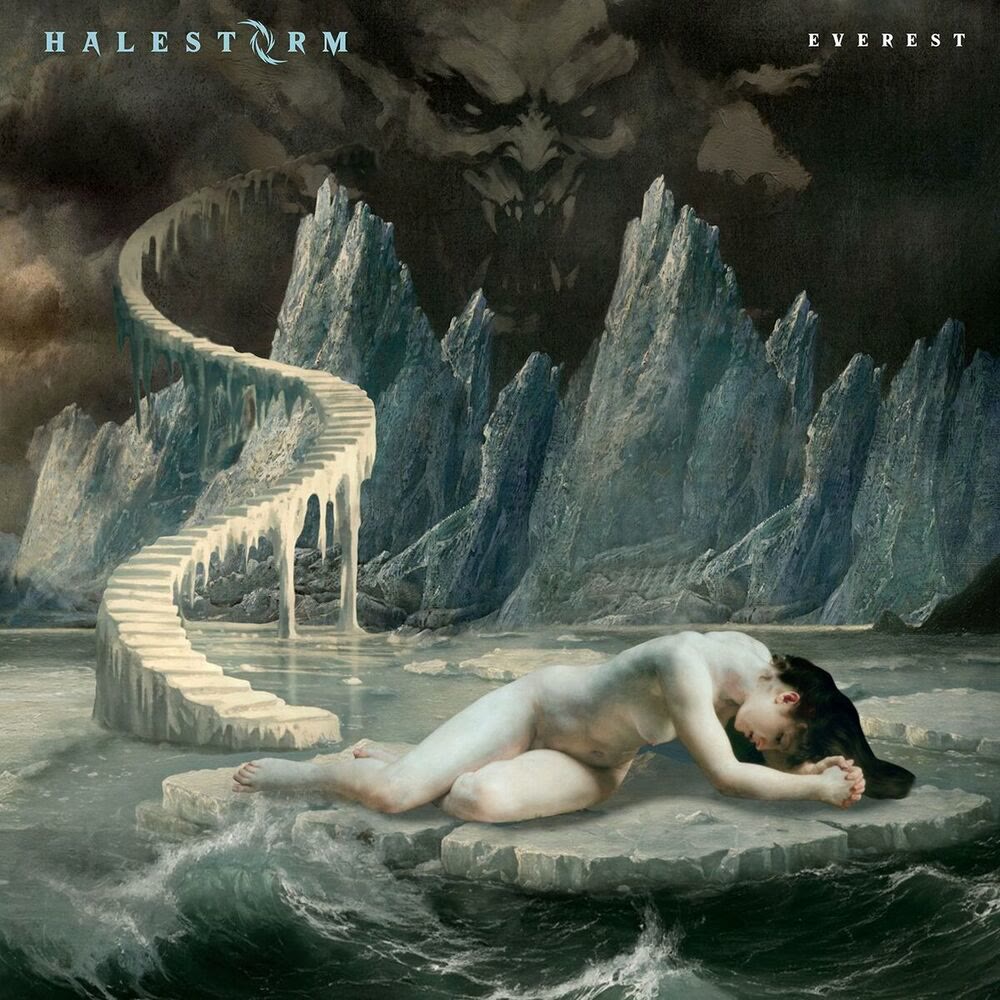
The record’s title became an image for both Hale’s recovery and the group’s artistic renewal. Climbing “Everest” is not the same as conquering it. There is no permanent victory waiting at the top, only another descent and another mountain. The album’s music reflects that instability. “Fallen Star ↗” carries the anxiety of self-doubt. “How Will You Remember Me? ↗” questions legacy, mortality and the fear that a life’s meaning may be impossible to measure. The title track transforms persistence into something almost physical: continuing upward because stopping would mean surrendering the self.
Hale’s voice remains enormous, but “Everest” is not built solely around vocal dominance. The production leaves room for grain, breath, uncertainty and sudden intimacy. The quieter passages matter because they make the eruptions feel earned. Cobb encouraged Halestorm to capture first or second takes, including vocal, guitar and drum performances before they could be smoothed into perfection.
That approach mirrors Hale’s emotional reset. Recovery often involves relinquishing the illusion of control. The music became stronger when the band stopped trying to force it into a predetermined shape.
“Rain Your Blood on Me”: fury with a pulse
“Rain Your Blood on Me ↗” is one of “Everest”’s most immediate expressions of artistic momentum. It carries the swagger of classic hard rock, but beneath the heavy guitars and commanding rhythm is the sense of someone reclaiming her body and voice.
The song received its live debut at Black Sabbath and Ozzy Osbourne’s farewell event, “Back to the Beginning”, in Birmingham on July 5, 2025. Halestorm also performed Ozzy’s “Perry Mason ↗,” placing Hale inside the musical lineage that shaped her from childhood.
For Hale, the event was more than another prestigious festival appearance. Black Sabbath represented a foundation. She has repeatedly said that she would not be the woman she is without Sabbath, and that appearing on the bill was both a personal achievement and a responsibility to the women coming after her.
The symbolism is powerful: a woman who once brought Sabbath records to school while her peers listened to pop idols now standing inside the world those records created. Yet Hale did not arrive there by becoming a replica of the men who came before her. She arrived by insisting that heavy music could contain her entire identity, her sexuality, her mental-health struggles, her theatricality, her tenderness and her rage.
“Rain Your Blood on Me” sounds like that insistence made physical.
“Like a Woman Can” and the politics of being understood
If “Rain Your Blood on Me” is the outward-facing roar, “Like a Woman Can ↗” is more intimate and mischievous. Built around a bluesy, waltzing feel, the song challenges the emotional and erotic limitations of a relationship in which one person refuses to learn how the other communicates.
Hale has explained that the song began with a Meryl Streep interview about the way women have historically learned the language of men while men have often failed to learn the language of women. The song became a demand for mutual effort, a request to meet in the middle, and also carried a bisexual subtext.
The writing is deliberately direct. It does not ask permission to be queer, sensual or dissatisfied. It does not soften desire to make a male audience comfortable. The official video expands that perspective through a cast and visual language centered on intimacy between women, turning the song into something more expansive than a conventional breakup track.
Hale’s sexuality has long been part of her public story, but “Everest” does not treat identity as a publicity device. It is simply one of the truths available to the songwriter. That is important in a heavy-music culture that has historically demanded toughness from women while reducing their bodies and desires to spectacle.
“Like a Woman Can” reverses the gaze. It asks what happens when a woman is not merely looked at, but listened to.
Carrying the women who came before
Hale’s understanding of women in rock is rooted in gratitude rather than isolation. She has spoken about Heart, Pat Benatar, Joan Jett and Lita Ford as artists whose persistence made her own path more possible. Their existence was a form of evidence: a woman could take up space, play hard, survive the industry and still remain fully herself.
Now Hale sees her own role in similar terms.
She has shared stages and collaborations with artists such as Amy Lee, including a celebrated version of Halestorm’s “Break In ↗,” and she has worked across stylistic boundaries with The Hu on “Song of Women ↗.” These connections matter because Hale’s career has never been about proving that she is the only woman who belongs in heavy music. It has been about making the room larger.
At “Back to the Beginning”, she was the only woman performing on a lineup filled with historic male figures. But she did not interpret that as isolation. She imagined the women in the crowd, the teenage metalheads, the longtime Sabbath devotees, the girls who had once felt like outsiders, and carried them with her.
That is the emotional center of Hale’s legacy. She is not trying to erase the barriers she encountered. She is trying to make sure the next singer, guitarist or drummer has to fight fewer of them.
Survival becoming momentum
Lzzy Hale’s creative reset did not make her invulnerable. If anything, it made her more willing to show the parts of herself that success had taught her to hide.
She still writes from instinct. She still chases the enormous vocal moment. She still loves the challenge of walking in front of an audience that does not know Halestorm and winning it over. But “Everest” reveals a different kind of confidence: not the confidence of someone who believes she can solve everything, but the confidence of someone who can admit she cannot.
That distinction is the album’s deepest achievement.
Hale’s survival is not presented as a finished story. It is an ongoing practice, staying sober, asking for help, protecting her peace, trusting her bandmates, questioning old regrets and continuing to make music without pretending that every wound has closed.
In that sense, “Everest” is not a monument. It is a working document.
It captures a woman who reached a dangerous ledge, looked down, and chose to keep climbing, not because she believed the view would save her, but because the act of moving forward had become its own form of freedom.