
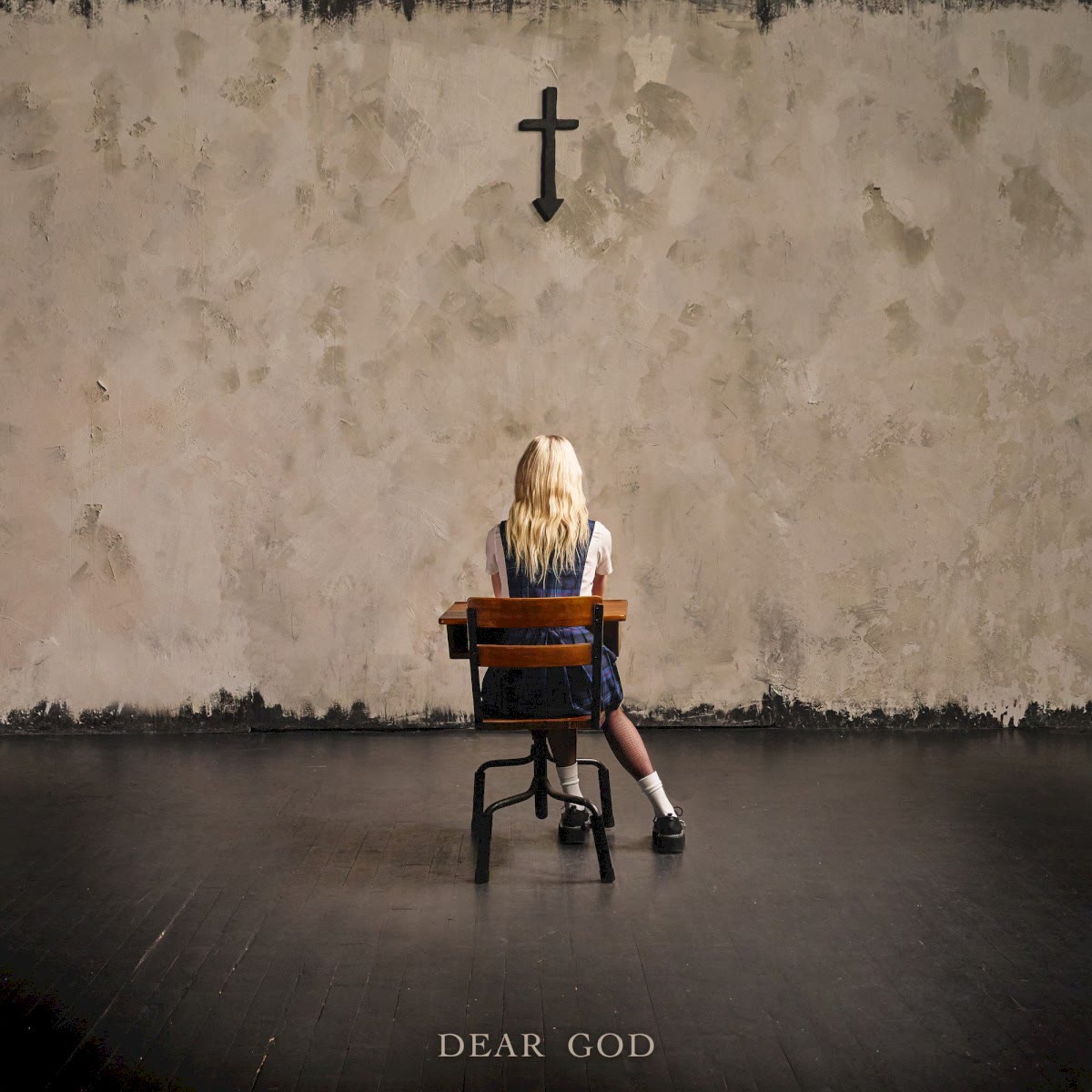
The record that took the long way home
The Pretty Reckless did not need another album to prove that Taylor Momsen could sing. She had already spent more than a decade turning a bruised, smoky alto into one of modern hard rock’s most recognizable voices. What “Dear God ↗” proves instead is that Momsen still has something unresolved to say, and that The Pretty Reckless remain at their best when the music gives her nowhere to hide.
Released on June 26, 2026, “Dear God” is the band’s fifth studio album and their first collection of new songs since 2021’s “Death By Rock And Roll”. Its arrival was delayed by an extraordinary detour: the band had begun recording when they were invited to support AC/DC, ultimately spending an extended period on the road with one of rock’s defining institutions. Momsen, Ben Phillips, Mark Damon and Jamie Perkins took the opportunity, then returned to finish the record.
The delay matters because “Dear God” sounds like a record that needed time to become honest. It is not simply another chapter in The Pretty Reckless’ established cycle of blues-rock swagger, grunge abrasion and stadium choruses. It is more exposed than that. Momsen has described the album as a “giant confession,” and the phrase fits: the songs move through depression, addiction, grief, mortality, loneliness and spiritual doubt without trying to tidy any of them into a neat redemption story.
“It really feels like the first record of a new band just getting started.”
That description, reported in interviews around the album’s release, may sound surprising from a group with four previous records and a substantial touring history. But it explains the album’s energy. “Dear God” does not feel like a band protecting a legacy. It feels like four musicians rediscovering the physical pleasure of playing together: guitar, bass, drums and voice pushed into the same room, with the songs allowed to breathe, crack and occasionally overreach. Momsen has called it the band’s least-produced and most natural-sounding album, a statement reflected in its directness.
From Cindy Lou Who to the woman behind the microphone
Momsen’s public story has always contained an uncomfortable contrast. Millions first encountered her as Cindy Lou Who in “How the Grinch Stole Christmas”, the bright-eyed child whose voice carried unexpected emotional weight. Later came Jenny Humphrey on “Gossip Girl”, a role that placed her inside the machinery of celebrity before she had fully decided what she wanted from it. Momsen eventually left acting behind and committed herself to music, becoming the singer, guitarist and principal emotional force of The Pretty Reckless.
That history is not a decorative backstory to “Dear God”. It haunts the record. The album repeatedly asks what remains when the public image falls away: the child star, the rebellious fashion figure, the rock frontwoman, the woman trying to understand her own survival. The title track’s reference to neighbors wondering whether “that little girl” has lost her mind turns the gaze of childhood acquaintances into something more complicated than simple judgment. It sounds like Momsen confronting the distance between the person other people remember and the person she became.
The remarkable thing is that she does not sing these songs as someone seeking to reclaim innocence. Her voice has too much mileage for that. On “Dear God”, she sounds older, rougher and more deliberate. The famous rasp remains, but it is no longer used only as an emblem of rebellion. It becomes a dramatic instrument: a low, grainy murmur when she is trying not to reveal too much, a hard-edged bark when self-loathing turns outward, and a full-throated cry when the songs finally break through restraint.
“For I Am Death”: mortality with a riff behind it
The album opens with the brief, spectral “Life Evermore Part 2” before dropping into “For I Am Death ↗,” a song that establishes the record’s central atmosphere immediately. The guitars arrive with grim authority, the rhythm section locking into a heavy, stalking pulse while Momsen places herself somewhere between narrator, threat and witness.
The song’s title invokes a line associated with the “Bhagavad Gita”, famously echoed by J. Robert Oppenheimer, but The Pretty Reckless do not treat the reference as an intellectual ornament. Here, death feels intimate and physical. It is not a distant philosophical concept; it is the shadow in the room, the force that appears in damaged relationships and destructive habits, the presence that can become almost seductive when life itself feels unbearable.
Musically, “For I Am Death” works because it refuses to soften its central idea. Phillips’ guitar part is broad and muscular rather than showy, built around a riff that seems to grind forward even when the song’s emotional subject is paralysis. Perkins plays with force but not clutter, giving the track a sense of inevitable motion. Momsen’s vocal performance is the centerpiece: controlled in the verses, increasingly feral as the song expands.
The band has been careful not to close off the song’s meaning. Momsen has said that once music is released, it no longer belongs exclusively to its creator. That openness is important here. “For I Am Death” can be heard as a meditation on mortality, addiction, grief or self-destruction. Its power lies partly in refusing to decide for the listener.
“Love Me”: the naked center of the album
If “For I Am Death” is the album’s warning, “Love Me ↗” is its wound.
Written early in the album’s creation, the song appears to have shown Momsen something about herself that she had not wanted to admit. She has described it as coming from a place of hollowness, from the moment when a person begins bargaining with God not for happiness but for evidence that somebody sees them.
That emotional simplicity is what makes “Love Me” so devastating. The song does not hide behind elaborate metaphor. Its central plea is almost embarrassingly direct: the need to be wanted, noticed and held in somebody else’s mind. The arrangement understands that the lyric should remain exposed. Rather than burying Momsen beneath layers of atmosphere, the band builds tension around her, letting the guitars swell and recede like pressure inside a sealed room.
Her vocal is extraordinary because it is not conventionally beautiful at every moment. There are frayed edges, swallowed syllables and a sense that the performance could collapse if she pushes it one step further. When she finally opens into the chorus, the sound is not triumphant. It is the sound of someone demanding an answer from an empty sky.
“Love Me” is the record’s standout track because it unites Momsen’s songwriting instincts with the band’s hard-rock identity. The song is heavy without being blunt, melodic without becoming sentimental, and personal without feeling hermetically private. The Pretty Reckless have written songs about lust, power, death and rebellion before. Here they write about the terrifyingly ordinary desire to matter to someone. That is the point at which “Dear God” becomes more than an exercise in darkness.
The title track: a prayer that keeps getting louder
The album’s title track is its emotional and structural centerpiece. Momsen has called it the record’s “opus,” and it earns that scale through patience. “Dear God” begins in a subdued, ominous space before gradually gathering weight. The song does not rush toward its climax; it approaches it like someone circling a confession they are afraid to make.
The guitars widen as the arrangement develops, but the song’s real drama comes from Momsen’s voice. She moves from weary questioning to open-throated desperation, transforming the title into something less like a religious statement than a direct address to whatever power might still be listening. The performance has the physical intensity of a live take: not polished into submission, but allowed to retain the grain, breath and strain that make it convincing.
“Dear God is desperation set to music.”
That description, attached to the song’s release, is exact. The track is not asking for easy salvation. It asks why life is the way it is, and whether there is any meaning in the wreckage. Momsen’s upbringing in the Catholic Church informs the imagery, but she has made clear that she is not presenting the album as an expression of organized religion. The “God” of the title can be understood as the universe, a higher power, the absent dead or the part of oneself still searching for a reason to continue.
The song’s length, more than six minutes, allows the band to make atmosphere part of the argument. “Dear God” is not designed as a compact radio statement. It unfolds, accumulates and finally breaks open. When Momsen reaches the song’s highest emotional register, it feels less like a singer demonstrating range than a person exhausting every other way of speaking.
After the confession, the world remains
The album does not stay in one emotional key. “When I Wake Up ↗” looks backward at excess and the nightmare that can follow it, moving from reckless exhilaration toward the morning-after consequences. Momsen described it as a dream turning into a nightmare, and the track captures that shift with restless rhythms and a vocal that sounds both amused and horrified by the life it is recounting.
“Dragonfire ↗” is one of the record’s most effective departures. Its shifting acoustic guitar figures and smoldering pace give the album a different kind of darkness, less apocalyptic than intimate. It is a reminder that The Pretty Reckless do not need maximum volume to create weight. The quiet spaces around Momsen’s voice become part of the arrangement.
“About You ↗” offers a burst of defiance, while “Spell On You ↗” turns revenge into theatrical witchcraft. The latter is intentionally campier, full of potions, spells and voodoo imagery, and it risks becoming too playful for the album’s otherwise bruised mood. Yet that tonal disruption is useful. Confession is not a straight line. People joke, posture, flirt and lash out even when they are carrying grief.
The album’s later sequence is especially affecting. “Eye Of The Storm” expands personal despair into a broader sense of social collapse. “Devil In Disguise (Michelle’s Song)” is a compact, grieving tribute to Momsen’s former “Gossip Girl” co-star Michelle Trachtenberg, who died in 2025. The song’s importance is not that it turns private grief into spectacle, but that it allows remembrance to sit beside the album’s larger themes of time, mortality and the people who disappear while life keeps moving.
“Dark Days” closes the main emotional arc with a heavy, world-weary trudge. It does not pretend that confession has solved everything. The record ends with “Life Evermore Part 1,” completing the album’s fragmented sequence but leaving no grand resolution. The circle closes without the wound being sealed.
A powerful record with rough edges
“Dear God” is not flawless. Its commitment to rawness occasionally works against it. The production can feel aggressively forward, particularly around Momsen’s vocals, while some of the drums lack the depth and dimensionality that the songs deserve. The album’s emphasis on catharsis sometimes comes at the expense of sharper editing; a few tracks feel more like emotional documents than fully distilled compositions.
But those weaknesses are inseparable from the record’s conviction. The Pretty Reckless are not chasing immaculate modern-rock surfaces here. They are pursuing immediacy. The performances sound designed to survive outside the studio, in a dark club or an arena where the crowd can shout the words back. That quality matters for a band whose identity has always been built around the tension between vulnerability and physical force.
Momsen’s position within rock also matters. She is not merely a former child actor who found a louder second career. She is a songwriter who has spent years insisting that music is the place where she is most fully herself. On “Dear God”, that insistence becomes impossible to dismiss. The old images, Cindy Lou Who, Jenny Humphrey, the young woman with the black eyeliner and the provocative stage persona, remain part of the story, but they no longer define the person singing.
The Pretty Reckless have made a record about what happens after the performance ends. “Dear God” asks what is left when the costumes, reputations and survival mechanisms fall away. Its answer is not comfort. It is a voice: cracked, enormous, still reaching.
That is why the album feels like a new beginning. Not because Momsen has escaped her past, but because she has finally turned toward it.