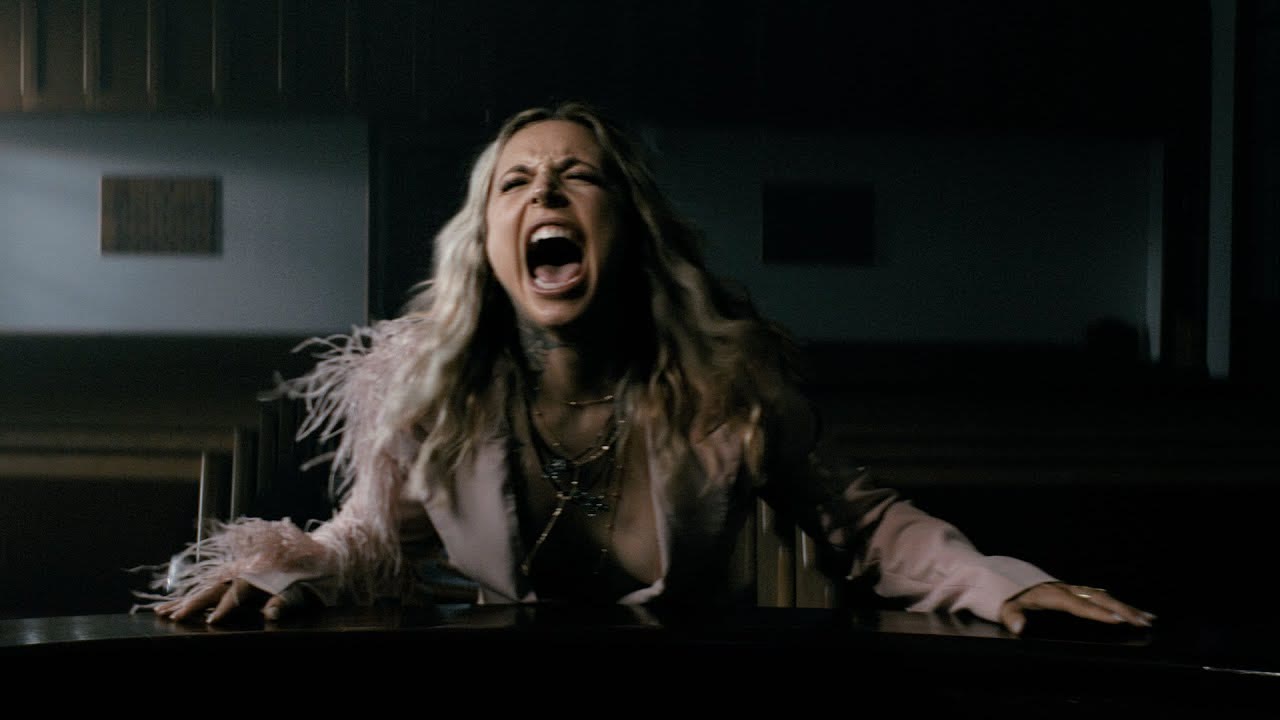
Haley Roughton spends her working days helping prepare people for one of humanity’s most unforgiving environments. Away from that work, she steps into a different kind of hostile territory, trading the precision of engineering for the chaos of metalcore. Her voice moves from delicate melody to monstrous growls, while her songs explore love, grief, anger, faith and the uncomfortable spaces where conflicting emotions refuse to resolve themselves.
The combination sounds like a carefully constructed publicity concept. It isn’t. Roughton has built a life in which both worlds are real, demanding and important to her.
As vocalist and creative driving force behind GORE., the Texas-based metalcore band, she has developed a sound that combines crushing guitars with R&B-inflected melodies, shoegaze atmosphere and an unusually vulnerable approach to heavy music. The band’s aesthetic places flowers, femininity and religious imagery alongside distortion, darkness and grotesque emotional subject matter. Its songs are interested in the parts of human experience that conventional narratives of strength often leave behind.
Her journey here was neither straightforward nor carefully planned. Before GORE., there were years spent performing in other people’s bands, a personal crisis that seemed to arrive all at once, and a period when becoming the person responsible for her own artistic future appeared more frightening than continuing along the familiar path.
Then came two EPs designed to tell a story across a year, culminating in …Then You Cannot Love Me, released on October 9, 2026. GORE. are now taking their music to increasingly large audiences, including recent European dates opening for I Prevail alongside Polaris and Amira Elfeky.
Roughton’s story is more interesting than the headline about a NASA engineer who sings metal. It is about what happens when a woman stops trying to fit the pieces of her life into a single, easily understood identity, and begins creating art that allows all of them to exist together.
A Different Kind of Career Path
Roughton wanted to study music when she went to college. Her family encouraged her to consider a more stable profession instead, and electrical engineering became the path she pursued. By the end of her studies, she had secured a position with a major scientific organisation.
That decision led to a career in the spacewalk programme at NASA’s Johnson Space Center in Houston. Her engineering work has involved training astronauts to use their equipment and contributing to the development of next-generation spacesuits, including those intended for future lunar missions.
The contrast between that responsibility and her work in GORE. is striking, but Roughton does not regard one life as a disguise for the other. In interviews with Metal Hammer and Revolver, she has spoken openly about the satisfaction she finds in both fields.
The engineering career also gave her something that many musicians spend years trying to obtain: financial stability while pursuing a creative ambition.
Roughton has been candid about the dangers of romanticising the financially precarious artist’s life. Making music does not become more authentic simply because someone struggles to pay the bills. For her, maintaining a profession outside music means she can build GORE. without making every artistic decision under the pressure of immediate commercial survival.
In an interview with Noir, she encouraged women pursuing demanding careers alongside their creative ambitions to work for what they genuinely love, rather than to satisfy other people’s expectations. She also warned against the idea that pursuing a dream requires sacrificing one’s health or living under constant financial stress.
Her own schedule is hardly relaxed. In an October 2026 interview with The Luna Collective, she described the arrangement as working from nine to five, then dedicating the evening to music. Tour dates consume vacation time, leaving relatively few genuine breaks.
I have my 9-5, and my 5-9.
The practical simplicity of that sentence conceals a considerable commitment. A metal band needs rehearsals, songwriting, recording, publicity, social media, travel and performances. Those responsibilities do not disappear when the working day ends. Nor does engineering become less demanding because the engineer also happens to front a band.
Roughton has acknowledged that her professional training has made her highly organised, deadline-conscious and results-driven. Those qualities are useful when an independent band must operate with limited time and resources.
There is an important qualification, though. Her method is demanding precisely because it depends on the time she can extract from an already full life. The arrangement works for her at this stage, but she has never pretended that maintaining two careers leaves much room for rest.
Still, the idea that a musician must choose a single identity has never seemed particularly convincing to her. The NASA engineer and the metal vocalist are not competing versions of Haley Roughton. They are two expressions of a woman who enjoys solving problems and creating things, even when the methods required are radically different.
Rock Bottom, Houston
Before GORE. became her own project, Roughton spent years working as a vocalist in other bands.
Her previous credits include Dorzia and The Xebellian Triangle, the latter a Houston-based death metal project with symphonic elements. She recorded vocals for The Xebellian Triangle’s 2022 album At the Banks of the Rubicon and contributed lyrics and arrangements to its single “Dracarys ↗.” Her earlier work included the more technical and extreme end of metal, an experience that would become important to the singer she eventually developed.
The next stage of her life did not begin with a triumphant decision to leave behind those experiences. It began with several painful changes arriving together.
In a 2025 Metal Hammer profile, Roughton described a period around 2022 when her relationship ended, she was dismissed from Dorzia and The Xebellian Triangle, and she had to move back in with her family. She did not attempt to dress the situation up as a calculated career transition.
I was at rock bottom, baby.
The remark carries a characteristic dark humour, but the circumstances behind it were serious. Her personal life had changed, two musical relationships had ended, and the career she had built within other people’s projects had suddenly become uncertain.
She had spent years joining bands, contributing her abilities and working within musical structures established by other people. That arrangement had advantages. She could concentrate on performing without having to carry the entire burden of constructing a band’s identity, financing its releases and deciding its future.
But losing those positions forced her to consider what she actually wanted to do with her own musical ideas.
Roughton later explained that working within someone else’s band was less frightening than starting her own. When someone else sets the direction, there is a defined structure to work within. Creating a new band means taking responsibility for the music, the decisions and the possibility that nobody will care.
The difficult period did not automatically produce a successful musical project. It gave her the circumstances in which she could no longer rely exclusively on the old arrangement.
That distinction matters. Artists often tell their histories as if personal suffering were a necessary ingredient in creative achievement. Roughton’s story suggests something more ordinary and more difficult: adversity created a decision she could not avoid, and she had to find the courage to act on it.
The end of her earlier band memberships did not erase the years of experience she had accumulated. It gave her a reason to use that experience differently.
Learning to Scream in a Houston Apartment
One of the most revealing details about Roughton’s development as a vocalist is how little it resembles a traditional metal singer’s origin story.
There is no elaborate mythology of a young prodigy discovering a voice through years of formal training. Roughton has described herself as a self-taught vocalist, and her account of discovering harsh vocals is refreshingly unceremonious.
In the October 2026 interview with The Luna Collective, she recalled dating a man who played in a metal band. After their relationship ended, she decided that learning to scream might not be as difficult as it appeared. She tried it in her small Houston apartment and discovered she could do it.
The anecdote is funny partly because of its understatement. A technique that can sound physically intimidating to an inexperienced listener began as an experiment in a private room, prompted by curiosity and an unwillingness to assume that something was beyond her.
It also offers a glimpse of her independence. Rather than waiting for another band to develop her abilities or for somebody else to tell her what she could contribute, she experimented until she found something worth pursuing.
Her vocal style now depends on the relationship between two apparently contradictory extremes. Clean singing can be soft, yearning and melodic, with the fluid phrasing and ornamentation of R&B. Harsh vocals can be low, guttural and genuinely abrasive. The contrast is not simply a way of making a breakdown more dramatic. It allows her to move between emotional states within a single song.
The delicate voice can suggest longing, uncertainty or a plea for affection. The scream can express rage, desperation or the feeling of having reached the end of one’s ability to remain composed. Neither register has to cancel out the other.
Roughton has described the challenge of recording “A Bud That Never Blooms ↗” as largely a matter of making the vocals communicate the right feeling. She experimented with details as small as variations in vibrato and mouth shape, treating vocal performance as an exercise in conveying meaning rather than simply hitting the required notes.
That attention to nuance helps explain why her singing can remain compelling even when GORE. is not operating at maximum intensity. The heavy sections have impact because the music makes space for fragility as well as force.
Her interests extend well beyond metal. In interviews, she has discussed her love of R&B, theatrical elements in music and the songwriting of Conor Mason of Nothing But Thieves. She admires the expressive possibilities of operatic vocal techniques within rock, while drawing on the harsher musical vocabulary she developed through her earlier metal projects.
The result is not a singer trying to prove that she can perform every technique available. It is a singer learning how those techniques can serve a particular emotional purpose.
The Sound of GORE.
The music that became GORE. began taking shape in 2022, when Roughton travelled to a studio in St. Louis to write songs with Ben McGuiness and Caleb Freihaut. She did not arrive with a complete concept for a band or a carefully mapped-out discography. According to her later account to The Luna Collective, she did not fully understand what the songs were meant to represent until the writing sessions were finished.
Those songs eventually formed the foundation of “A Bud That Never Blooms”.
The sound suggested a direction she had not encountered in quite the same combination: metalcore weight, atmospheric guitars, melodic passages, R&B phrasing and a willingness to let vulnerability remain audible even when the music became aggressive.
Roughton approached guitarist Alex Reyes, whom she knew through the Houston scene, and bassist Devin Birchfield, with whom she had been friends online for years. The band subsequently developed into a quartet with drummer Wills Weller, formerly of progressive metal band Toothgrinder, who joined in 2024 after being introduced through the label.
GORE. did not begin as a band assembled to follow an existing market trend. Its sound emerged from the songs, and the visual identity followed the music.
The official formation dates are generally given as 2023, although Roughton traces the creative process back to the 2022 writing sessions. That distinction helps explain why the band arrived with a relatively clear artistic identity despite being a new name in the scene.
Their first single, “Pray ↗”, appeared in December 2023, followed by “Doomsday ↗” in January 2024. The songs quickly attracted attention online, helping GORE. secure a record deal with Spinefarm Records in 2024. The band received public support from established acts including Motionless in White, Papa Roach and Flyleaf.
The debut EP, A Bud That Never Blooms, arrived on October 24, 2024. It contained five songs that introduced the project’s defining concerns: painful relationships, social injustice, femininity, family and the collision between what people want from life and what they actually experience.
The title itself suggests a life that has not developed according to its imagined potential. The songs explore that idea from several directions, refusing to reduce disappointment to a single source.
“Pray” deals with unrequited love and the ache of wanting someone to remain present. “Doomsday” turns outward, addressing inequality and police violence. “Angels Like You ↗” examines the cruelty that can hide behind a self-righteous public image. “Heaven Is Above Me ↗”, the first GORE. song written, explores a deeply painful parent-child relationship.
The EP’s emotional centre, however, is “Babylon ↗”.
Femininity Without the Convenient Answers
Roughton’s comments about “Babylon” are among the most revealing statements she has made about her identity as an artist.
The song explores her desire for a loving home, marriage and children, alongside the fear that those hopes were becoming less attainable as time passed. It is a subject she felt was rarely addressed by metalcore bands, particularly when female empowerment was often expressed through narratives of independence, toughness and refusing to rely on anyone else.
She does not reject those narratives. She has acknowledged their importance in creating space for women within a male-dominated genre. Her objection is to treating them as the only acceptable way for a woman to appear strong.
Roughton wanted to write about the yearning for affection and family without disguising it as a declaration of independence. She wanted to acknowledge that some people genuinely want a traditional domestic life, and that the possibility of not achieving it can bring grief, frustration and a sense of failure.
The song was written during a period when she feared she might remain alone and without children. In a later interview with Noir, she explained that revisiting the material could still be emotionally difficult, although she had since found a different sense of purpose and happiness.
That later perspective matters because it prevents “Babylon” from becoming a permanent definition of its author. It documents a particular emotional reality rather than declaring that the future must resemble the fears that inspired it.
There is a temptation in heavy music to equate vulnerability with confession and confession with a simple truth. Roughton’s work is more complicated. She places intensely personal feelings inside songs that also address broader social questions, allowing private disappointment and public injustice to coexist.
Her approach to femininity is similarly expansive. In a 2024 interview with FemMetal, she explained that she wanted GORE. to foreground the delicate and nurturing sides of femininity, while retaining a sound capable of being disturbing, distorted and aggressive.
That ambition is reflected in the band’s visual presentation. Flowers and softness appear alongside grotesque imagery, dark religious symbolism and the physical force of metalcore. Beauty is not presented as a clean alternative to ugliness. The two are deliberately placed together.
It is an aesthetic that resists the assumption that feminine presentation must be either conventionally attractive and passive or aggressively defiant. Roughton is interested in the tension between those categories, including the ways gentleness can coexist with anger and desire can coexist with fear.
Her position is not that all women should identify with her experiences. It is that women should be permitted to express different experiences without being treated as exceptions to the genre.
She has also spoken about the persistent double standards that accompany female musicians in heavy music. A negative reaction to a song can quickly become a complaint about female vocals in general, or a suggestion that women in metal are simply following a trend.
Her response is direct:
Women in music isn’t any more of a trend than men in music.
In a separate interview, she expressed the hope that women would become numerous enough in heavy music that female-fronted bands would no longer be repeatedly compared with the same handful of successful acts, even when their music has little in common.
The ambition is bigger than representation in a promotional photograph. She wants enough women making different kinds of music that their gender no longer becomes the dominant framework through which their work is interpreted.
GORE. contributes to that possibility by presenting a woman who can be delicate without becoming timid, aggressive without making aggression her entire identity, and openly interested in romance without surrendering her independence.
“A Bud That Never Blooms”: Turning Personal History into Songs
What distinguishes Roughton’s songwriting is the refusal to divide the personal from the political into separate compartments.
On “A Bud That Never Blooms”, the longing of “Babylon” sits beside the social anger of “Doomsday”. The pain of “Heaven Is Above Me” belongs to a family relationship, but the song also examines the distance between the love a parent claims publicly and the love a child experiences privately.
The band’s work is not built around the assumption that every song must offer a solution. Some experiences remain unresolved, even after they have been written down.
That can be heard in the way the music handles contrast. Clean vocals may create a sense of openness without delivering relief. A heavy section can express anger without promising victory. The shift between the two registers allows a song to move emotionally without forcing it toward a conventional resolution.
Roughton has said that recording vocals was her favourite part of making the debut EP. She approached each phrase as an opportunity to shape the listener’s perception of the words, paying attention to minute differences in delivery.
The work was painstaking, but it was also where her identity as a singer and songwriter came together. In a genre where technical force can easily become the primary measure of a vocalist, she treated the emotional function of a performance as equally important.
The other challenge was less musical: the daily work of promoting the band through social media. In the same FemMetal interview, she described the repetitive demands of posting and sharing content, while acknowledging that the work had helped GORE. find its audience.
It is an uncomfortable part of contemporary independent music. The artist who wants to spend time making songs must also become a promoter, content producer and public representative of the project. The machinery of visibility demands a continuous stream of activity that can compete with the work it is supposed to support.
Roughton has been frank about finding this exhausting. She has also approached the problem pragmatically, drawing on the organisational skills developed through her engineering career.
The challenge is to ensure that the band remains a creative project rather than becoming a constant obligation to feed an algorithm.
From a Debut EP to a Two-Part Story
GORE.’s second EP, If You Do Not Fear Me…, arrived on October 3, 2025. It expanded the band’s interest in relationships, power, fear and resentment while retaining the contrasts between melodic singing and crushing instrumentation.
The record included “Wrath ↗”, “Sepsis”, “Orbiting” and “Like You Meant It”. Its visual identity embraced dark fantasy, particularly in the video for “Wrath”, which Roughton described as a kind of “Disney Princess Metal” experience. The cinematic story gave her a role that begins with vulnerability and develops into something far more unsettling.
The band also continued to explore the use of religious imagery without reducing it to either worship or provocation. For Roughton, Christianity is part of the cultural and emotional world through which many people understand love, guilt, sacrifice, judgement and redemption. Those symbols can be used to examine the human condition without requiring a song to deliver a doctrinal conclusion.
The next release was conceived as a continuation rather than a separate creative statement.
…Then You Cannot Love Me, released on October 9, 2026, completes the pair of EPs whose titles form a single conditional thought. The new seven-track collection includes “What You Paid For”, “Lead Me to the Slaughter”, “Bones in the Garden”, “Crucified”, “Walk on Water”, “Hallowed Ground” and “Alone”.
The two releases were designed to be distinct but inseparable. Roughton explained to Spinefarm Records that the earlier EP leaned toward a more ominous, cynical sound, while the newer material moves toward a brighter style that better reflects where the four members want GORE. to go together.
Musically, that development means more singing and more memorable choruses. The lyrics remain dark, but the arrangements are becoming more open and more deliberate in their use of melody.
The connection between the two records lies in their treatment of relationships in which love and fear become difficult to separate. The band has explored the contradictory emotions that can keep people attached to painful situations, particularly where affection, dependence, control and unequal power become entangled.
The titles reflect that contradiction. The first suggests that fear may be necessary to maintain love; the second pushes the implication further, questioning what kind of love exists when fear becomes part of its conditions.
Roughton has spoken about the expectations imposed on women and men within unhealthy relationships. Women can grow up believing that a man must fear losing them in order to love them, while men can be encouraged to appear emotionally detached. Those expectations can leave both people carrying wounds into relationships, even when the relationship itself offers no simple explanation for what has gone wrong.
The music does not pretend these patterns are easy to escape. It explores the point at which desire and self-preservation become difficult to reconcile.
“Crucified”, one of the new EP’s singles, focuses on the attraction of someone who draws another person toward temptation while fully understanding their influence. Roughton describes a relationship in which resistance becomes entangled with pleasure, and the knowledge that a person may bring chaos does not necessarily make the attraction disappear.
It is a recognisable human predicament, made more disturbing by the music’s willingness to let fascination and danger occupy the same space.
The two EPs also demonstrate a band becoming more confident in its own sound. Rather than repeating the approach that first attracted attention, GORE. has used the time between releases to develop its arrangements, experiment with new collaborators and move toward a more unified identity.
That evolution is important for Roughton. She has repeatedly argued that musicians are more likely to find an original voice when they draw inspiration from outside metal instead of trying to reproduce whatever has recently succeeded within the genre.
Her interest in R&B, theatrical elements, melodic rock and atmospheric music is therefore not decoration added to a metalcore foundation. Those influences are part of the way she understands her voice and the emotional territory she wants to explore.
What Happens When the Music Leaves the Studio
The public response to GORE. grew quickly after the first songs appeared online. The band’s early success brought record-label support, touring opportunities and recognition from established artists. Yet attention brings its own pressures, particularly for a group still developing its musical identity.
In 2025, GORE. toured with Within the Ruins and appeared at Download Festival. The band followed the debut EP with “Sepsis”, its first new music of 2025, and continued to develop its live performance.
The lineup was strengthened by Wills Weller’s arrival on drums, bringing experience from Toothgrinder and the wider progressive metal scene. With guitarist Alex Reyes and bassist Devin Birchfield alongside Roughton, the band had a quartet capable of translating its studio contrasts into a more physically immediate live sound.
By the summer of 2026, GORE. had toured with Kittie. Later in the year, the group took its new material across Europe as an opening act for I Prevail, appearing alongside Polaris and Amira Elfeky.
Roughton admitted she had some anxiety about how “Crucified” would be received on a bill with a heavier overall sound. The response proved encouraging. The experience suggested that the band’s mix of melodic passages and abrasive weight was reaching listeners beyond the audience already familiar with its online releases.
It also placed the band’s artistic identity in front of a wider range of metalcore fans. GORE. does not have to abandon its unusual combination of softness, theatricality and aggression to fit into a heavier setting. Those contrasting elements are part of what makes its performances distinctive.
The recent run of touring is a considerable achievement for a band whose vocalist still works a demanding engineering job. It also underlines the difference between the viral attention that initially introduces listeners to a group and the sustained work required to build an audience.
A song can attract attention overnight. A band must still turn that attention into relationships with listeners, convincing performances and a body of work that gives people a reason to return.
Roughton knows this from both sides of her life. Engineering requires reliability and planning; a creative career requires enough room for discovery and experimentation. GORE. must operate within the realities of both.
The Work of Being Heard
Roughton’s experiences have not made her dismissive of the metal scene, despite her awareness of its inequalities.
She has expressed gratitude for the people who supported GORE. from the beginning, and for the listeners who continued to follow the band as its audience expanded. At the same time, she has been critical of the pressure to turn creative work into a permanent social media performance.
Her approach to making music is rooted in detail. She is interested in how a tiny adjustment in vocal delivery changes the meaning of a line, how a melody can communicate longing without becoming sentimental, and how an arrangement can move between beauty and ugliness without losing its coherence.
That attention to craft is a more useful explanation for GORE.’s identity than the novelty of its frontwoman’s occupation.
The NASA connection is extraordinary, but it does not explain why the music resonates. A demanding technical career may help Roughton organise a project and execute its plans, yet the songs work because they engage with emotions that do not yield to the same kind of orderly problem-solving.
Love can exist alongside resentment. Faith can coexist with anger at the institutions and people who claim to represent it. A person can want independence while yearning for a family. Someone can recognise that a relationship is damaging and still feel its pull.
These are precisely the contradictions that GORE. refuses to simplify.
In this sense, Roughton’s artistic perspective differs from a conventional story of empowerment. Her songs do not need their narrator to emerge victorious or to prove that she never needed anyone else. They allow her to remain uncertain, wounded, angry or hopeful without turning those states into a verdict on her worth.
For a woman working in a genre where female performers can still be treated as representatives of an entire category, that openness is significant. It makes space for an artist to be judged by the complexity of her work rather than by whether she conforms to a preferred model of what a female metal vocalist should be.
Haley Roughton, on Her Own Terms
As of October 28, 2026, Roughton stands at a point where the various parts of her musical life are beginning to reinforce one another.
GORE. have released three EPs since the project took shape, developed a recognisable sonic and visual identity, signed with Spinefarm Records and built a touring presence that reaches beyond their original audience. The newest record completes an ambitious two-part concept while opening the door to a more melodic direction.
The group is still growing, and its longer-term future remains unwritten. There is no need to describe it as a finished success story. Its significance lies partly in the fact that the music continues to evolve, and that Roughton is doing the work of building a band rather than simply maintaining a role within one.
She has also moved beyond the circumstances that once made her feel that her life had collapsed. The experiences behind “A Bud That Never Blooms” remain part of her work, but they do not define everything she is now. The later EPs show an artist returning to similar themes from different angles, allowing time and new experiences to alter the music’s emotional perspective.
Perhaps the most useful lesson from her story concerns the idea that a creative ambition must justify itself by becoming a full-time occupation. Roughton pursued a stable professional career because that was the path encouraged by her family. She later returned to music as the driving force behind her own project, retaining the career she had built rather than treating it as a betrayal of her artistic identity.
That choice challenges the romantic idea that the only authentic musician is one who risks everything. It also offers a practical model for women navigating industries that do not always provide equal opportunities or reliable financial rewards.
Roughton is not suggesting that every aspiring musician should follow her exact path. She is demonstrating that the choice need not be between abandoning a creative dream and abandoning every other part of one’s life.
Her music makes a related argument. Femininity need not mean softness alone, and strength need not require the rejection of vulnerability. Metal can hold both the delicate and the grotesque, the desire to be loved and the fear of what love can demand. A singer can move from an almost whispered melody to a visceral growl without having to choose which one represents her more honestly.
GORE. calls its approach emotional gore. The phrase captures the unsettling territory where the band’s music lives: the places in human relationships that people would rather conceal, but cannot always escape.
Roughton’s achievement is not that she has turned pain into a convenient success narrative. It is that she has made a body of music where pain, tenderness, anger and ambition can remain in the same room without any of them having to apologise for being there.
She has no single identity to defend, no one musical register to inhabit and no obligation to present a simplified version of herself for the sake of the story.
There is the engineer who values precision and the vocalist who embraces distortion. There is the woman who can discuss the practicalities of funding and organising a band, then spend hours adjusting the smallest details of a vocal performance. There is the metal musician who loves melody, the feminist who does not want to write only about independence, and the songwriter who is willing to admit that longing can hurt even when it remains deeply human.
Those parts do not make Haley Roughton difficult to understand. They make her music worth listening to.
And as GORE. moves into its next chapter, that may be the most important thing about her: she has stopped waiting for someone else to decide which version of herself belongs in the band.