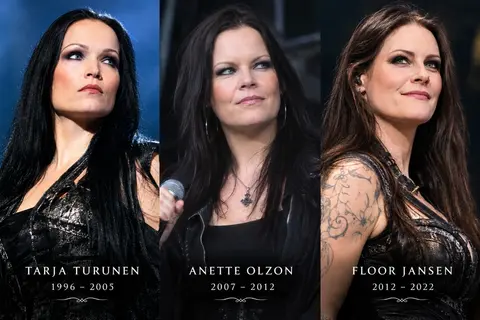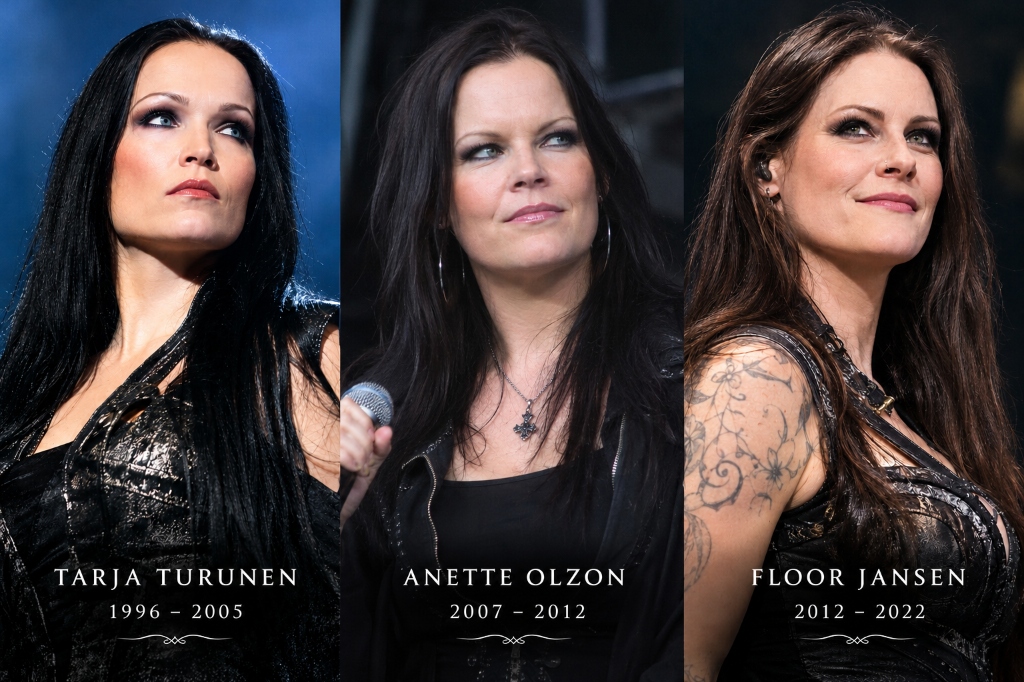
Nightwish’s history usually gets told through its three vocalists: Tarja Turunen, the classically trained soprano who anchored the band’s early power-metal records; Anette Olzon, who stepped in after the 2005 split; and Floor Jansen, who fronted the group for more than a decade before her departure in October 2026.
Yet the lasting shifts in how the Finnish band sounds happened inside the studio. Across thirty years, keyboardist and principal songwriter Tuomas Holopainen moved from cheap synth patches in Kitee rehearsal rooms to full London orchestral sessions, shifting arrangements, and multi-vocalist storytelling. Those studio choices gave symphonic metal much of its modern template.
Below is a ranking of the five Nightwish studio albums that did the most to reshape the band’s sound and widen what symphonic metal could pull off.
5. “Human. :II: Nature.”: the world opens outward
Released on 10 April 2020, “Human. :II: Nature.” was Nightwish’s ninth studio album and their second with Floor Jansen. Spread across two discs, it paired nine vocal tracks with an eight-part orchestral and instrumental suite, “All the Works of Nature Which Adorn the World ↗”.
By 2020, Holopainen had moved well away from the fantasy and gothic folklore that defined the band’s early catalogue. “Human. :II: Nature.” focuses on human invention, ritual, evolution, and our fraught relationship with the natural world. Songs like “Music ↗”, “Noise”, “Shoemaker”, “Harvest”, “Tribal”, and “Procession” lean on jagged rhythmic shifts, tribal percussion, and acoustic folk instrumentation alongside heavy riffs, before the second disc drops distorted metal guitars altogether.
Jansen has spoken openly about what it takes to sing inside Holopainen’s keyboard-led compositions, which arrive largely formed before any vocalist tracks a line:
The reason why Nightwish sounds the way it does is because Tuomas Holopainen writes the music.
- Floor Jansen
Rather than pushing Jansen into nonstop operatic belts, “Human. :II: Nature.” uses her voice with surprising restraint. On “How’s the Heart?”, she delivers warm, direct phrasing over Troy Donockley’s uilleann pipes and acoustic guitars; on “Shoemaker”, she pivots into full classical soprano for the closing tribute to geologist Eugene Shoemaker. The band kept their familiar workflow - writing and rehearsing in Finland before recording orchestral parts in London and finishing vocal tracking back home - and released the record right as pandemic lockdowns reshaped how fans heard a song like “Noise”.
4. “Endless Forms Most Beautiful”: science replaces fantasy
Released in March 2015, “Endless Forms Most Beautiful” introduced Floor Jansen as Nightwish’s studio vocalist and made multi-instrumentalist Troy Donockley an official permanent member. It also marked the moment Holopainen traded escapist fantasy for evolutionary biology and natural history.
Taking its title from the closing paragraph of Charles Darwin’s “On the Origin of Species”, the album draws directly on Darwin and astronomer Carl Sagan. It could easily have turned dry or didactic, yet tracks like “Our Decades in the Sun”, “The Eyes of Sharbat Gula”, and “Weak Fantasy” stay anchored in personal grief, anger, and awe. At the end sits “The Greatest Show on Earth ↗”, a 24-minute closer tracing the history of life on Earth with spoken narration from evolutionary biologist Richard Dawkins.
Preparation for the sessions in Finland was unusually demanding: the band logged more than eighty minutes of instrumental demos during rehearsals before tracking orchestral arrangements in London with Pip Williams. The sessions also weathered a major lineup blow when drummer Jukka Nevalainen stepped back due to severe insomnia, bringing Wintersun and Swallow the Sun drummer Kai Hahto in behind the kit.
Jansen brought experience from After Forever and ReVamp, yet she chose not to push her own songwriting onto Holopainen’s material or try to mimic “the new Tarja”. Her versatility let Nightwish move smoothly from brisk singles like “Élan” to sprawling progressive passages without sounding fragmented.
3. “Dark Passion Play”: surviving the rupture
Few metal albums arrived under heavier pressure than 2007’s “Dark Passion Play”. After Nightwish dismissed Tarja Turunen in an open letter following their Helsinki concert on 21 October 2005, much of the metal press wondered if Holopainen could keep the band alive without its founding voice.
The group sifted through more than 2,000 demo submissions before hiring Swedish singer Anette Olzon, whose identity stayed secret while the band tracked at Petrax Studios in Hollola, Finnvox in Helsinki, and Abbey Road in London. Rather than hiding the turmoil, “Dark Passion Play” put it front and centre.
Opener “The Poet and the Pendulum ↗” runs nearly fourteen minutes of self-critique, heavy orchestration, and sudden dynamic drops, while “Bye Bye Beautiful” tackles the Turunen split head-on. Elsewhere, “Amaranth ↗” delivers one of the catchiest hooks in the band’s catalogue, “The Islander” spotlights Marco Hietala and Troy Donockley’s acoustic folk streak, and “Master Passion Greed” pushes the band’s thrashier side harder than anything they had recorded before.
Olzon often caught unfair comparisons to Turunen, yet her pop-rock clarity and vulnerability gave songs like “Amaranth” and “Eva” an immediacy that an operatic soprano wouldn’t have brought. Recorded in snowy isolation at Petrax away from media noise, “Dark Passion Play” proved Nightwish could absorb a bitter public breakup and come back with one of their sharpest, darkest records.
2. “Once”: symphonic metal goes widescreen
Released in May 2004, “Once” turned Nightwish from a popular European club act into an international festival headliner. It was also the final studio album recorded with Tarja Turunen.
Up to 2002’s “Century Child”, Nightwish’s symphonic weight leaned heavily on Holopainen’s keyboards and smaller string ensembles. On “Once”, the orchestra became the backbone of the arrangements. Working with London arranger Pip Williams and the London Session Orchestra, the band poured money into recording real strings, brass, and choir at a scale rarely heard in European metal at the time.
We wanted to have the best no matter the costs.
- Tuomas Holopainen
Holopainen later noted that the orchestral production alone cost roughly double the budget of the band’s entire previous album. You can hear that investment in every bar: “Dark Chest of Wonders ↗” hits with widescreen brass, “Planet Hell” rides pounding choral stabs, and “Nemo” gave the band an international radio and MTV breakthrough. “Wish I Had an Angel” mixed industrial stomp with Turunen’s soaring chorus, while ten-minute centrepiece “Ghost Love Score ↗” set the gold standard for cinematic symphonic metal.
“Once” also showed how much Holopainen had learned about writing for Turunen’s soprano, giving her dramatic breathing room around dense orchestrations instead of burying her under double-kick drums. Behind the scenes, though, the tour behind “Once” pushed personal and management tensions past breaking point, making this artistic peak the end of the original era.
1. “Oceanborn”: the blueprint catches fire
Released on 30 May 1998, Nightwish’s second album “Oceanborn” remains the record where the whole blueprint clicked. Where 1997 debut “Angels Fall First” sounded tentative and folk-leaning, “Oceanborn” arrived fast, ferocious, and completely unafraid of melodrama.
Tracked in Finland with longtime producer and engineer Tero Kinnunen and mixed by Mikko Karmila at Finnvox Studios, “Oceanborn” fuses European power-metal speed with gothic keyboard leads and classical soprano vocals. Tracks like “Stargazers ↗”, “Gethsemane”, “Devil & the Deep Dark Ocean”, “Sacrament of Wilderness”, and “Sleeping Sun” pack dramatic tempo shifts, neoclassical keyboard duels, and soaring hooks into tight, urgent songs.
Tarja Turunen was still in her early twenties during the sessions, and she later recalled that Holopainen was still learning how to write comfortably for a classical soprano, making the vocal tracking gruelling. That friction gives “Oceanborn” an edge later, smoother productions never quite replicated. Turunen doesn’t float politely above the band on “Devil & the Deep Dark Ocean” or “Passion and the Opera” - she cuts straight through galloping riffs and growled male counter-vocals, while “Sleeping Sun” proves she could strip the drama down to pure stillness.
Before Nightwish could afford London orchestras, “Oceanborn” got its symphonic punch from layered synths, tight arrangements, and sheer conviction in a close-knit Finnish studio. Countless symphonic metal bands spent the next two decades chasing the sound Holopainen and Turunen stumbled into here, and “Oceanborn” still crackles with the thrill of a young band realising it had found something original.
Five records, one stubborn studio thread
Across twenty-two years separating “Oceanborn” and “Human. :II: Nature.”, Nightwish reinvented its lineup and themes more than once, moving from power-metal fantasy to widescreen film scores, bitter transition, and evolutionary epics. Through every shift, Holopainen’s studio discipline - building piano demos first, testing new textures, and pushing vocalists out of their comfort zones - kept those five albums standing as landmarks of the genre.